
💡 In This Guide:
If you have ever felt like your internal IT team spends more time fighting network fires than focusing on strategic projects, you are not alone. Managing a modern network is complex, time-consuming, and expensive. That is exactly why so many businesses are turning to Managed Network Services (MNS) — handing over day-to-day network responsibility to an outside expert so your team can focus on growth.
In this guide we walk through exactly what managed network solutions include, which types fit different business sizes, and how to pick the right partner for your organisation. We also look at trends like AI-Driven Network Operations (AIOps) that are reshaping the managed services landscape in 2026 and beyond.
1What Are Managed Network Solutions in IT Outsourcing?
Definition and Core Concepts
Managed Network Services (MNS) refer to a model where an external IT Outsourcing Provider takes operational ownership of your network infrastructure. This includes your Local Area Network (LAN), Wide Area Network (WAN), wireless infrastructure, and security devices such as firewalls. The provider monitors, maintains, configures, and troubleshoots — everything — in exchange for a predictable monthly subscription.
Managed Networking vs Traditional Network Administration
Traditional network administration relies on internal staff or contractors. You buy the equipment, hire the engineers, manage training, and deal with turnover, vacations, and skill gaps. Managed Network Services flips this model entirely.
| Dimension | Traditional Administration | Managed Network Services |
|---|---|---|
| Accountability | Internal staff — blame is diffuse | Provider holds contractual SLA obligation |
| Expertise | Limited to staff currently employed | Full team of certified specialists on demand |
| Cost model | Variable — salaries, training, hardware capex | Predictable monthly subscription |
| Coverage | Business hours unless overtime paid | 24/7 NOC monitoring included |
| Scalability | Requires hiring and procurement cycles | Add locations in hours via cloud provisioning |
| Downtime response | Best effort — no financial penalty | Service credits if SLA targets missed |
2
Why Do Businesses Outsource Network Management?
The decision to outsource network management usually comes down to four compounding pressures that internal teams cannot sustainably absorb.
Operational Benefits
Running a network requires constant attention. Someone has to monitor for outages, apply security patches, update firmware, track bandwidth usage, and troubleshoot problems every single day. When you outsource, your internal IT staff focus on projects that move the business forward instead of spending Tuesday morning figuring out why a switch failed.
Cost Reduction Opportunities
Hiring and retaining skilled network engineers is expensive and increasingly competitive. Salaries for experienced professionals continue to rise, and that is before adding benefits, training, certification costs, and recruitment fees. A managed service converts these unpredictable expenses into a predictable monthly fee. Industry analysts consistently report 20–50% reductions in total network operating costs when businesses move from in-house to managed models.
Access to Specialised Expertise
Network technology changes fast. Managed providers employ engineers certified by Cisco Systems, Juniper Networks, Fortinet, and VMware — specialists in SD-WAN, cloud networking, wireless design, and security. You access this entire team for less than the cost of one senior internal engineer.
Improved Service Availability
Managed providers run 24/7 Network Operations Centers (NOC) with redundant monitoring. They detect problems before you notice them and have defined escalation paths to resolve issues quickly. The result is higher network uptime than most internal teams can achieve on their own.
3
Types of Managed Network Solutions Available
Not all Managed Network Services are the same. Different businesses need different approaches. Here are the main types you will encounter when evaluating providers.
Managed LAN Services
Covers switches, routers, and cabling within a single location. The provider monitors switch health, port usage, VLAN configuration, and firmware updates. Best for offices, warehouses, and campus networks with multiple buildings.
Managed WAN Services
Connects multiple locations — headquarters, branch offices, and data centres — into a unified enterprise network. Provider manages routers, circuit performance, and failover across all sites. Works with your ISPs directly when circuits have problems.
SD-WAN Solutions
Intelligent software routes traffic across MPLS, broadband, and 4G/5G simultaneously. Provider handles configuration, policy creation, and ongoing optimisation. Video conferencing gets low-latency links; backups use cheaper broadband. Centralised management — no on-site engineers needed.
Cloud Managed Networking
Control panel lives in the cloud — no on-premises controllers. Ship a pre-configured device to a new site, plug it in, and it calls home to download its full configuration automatically. New sites go live in hours instead of weeks. Popular from HPE Aruba and Extreme Networks.
Wireless Network Management
Site surveys, access point configuration, radio frequency tuning, and guest network management. Provider ensures Wi-Fi works everywhere it should and handles roaming as people move through your space. Essential for hospitality, healthcare, and education environments.
Hybrid Network Management
Ties together MPLS circuits, broadband internet, 4G/5G backups, and hybrid cloud connections to AWS, Azure, or Google under one managed service. Provider presents a unified dashboard even though the underlying technologies are completely different.
4
How SD-WAN Improves Outsourced IT Operations

SD-WAN deserves its own section because it has changed the managed network landscape more dramatically than any other technology in the past decade.
Traffic Optimisation and Application Prioritisation
Traditional WANs treat all traffic identically. A critical video conference competes with a massive software download on the same link. SD-WAN identifies traffic types — including encrypted traffic — and routes each one intelligently. Salesforce, Office 365, Zoom, and your internal ERP system each get their own policies. When the network is congested, the provider automatically protects your most important applications first.
Centralised Management
Managing a traditional WAN means logging into each router individually at each site. That is slow, error-prone, and expensive. SD-WAN provides a single management pane where your provider can see every site, every connection, and every policy. They make a change once and the system pushes it everywhere — making remote outsourcing fully practical.
Reduced Network Complexity
A branch office might have a dedicated internet access (DIA) line as primary, a cable modem as backup, and a 5G hotspot for emergencies. SD-WAN handles failover between all three seamlessly. Users never notice when a circuit fails because traffic shifts automatically within milliseconds.
5
Essential Features of the Best Managed Network Solutions
When you evaluate providers, these features separate basic monitoring contracts from genuinely managed services.
24/7 Network Operations Centre (NOC) Monitoring
Your network does not sleep, and neither should your monitoring. The best providers run NOCs around the clock, monitoring every device, every link, and every critical service. Monitoring should be proactive — detecting high error rates, failing hardware, or bandwidth saturation before they cause outages. Synthetic transactions that simulate real user activity catch problems that simple uptime pings miss entirely.
Automated Issue Detection and Configuration Management
Manual monitoring does not scale. Top providers use machine learning to detect anomalies and correlate events across multiple systems simultaneously. If a switch starts dropping packets and a router reports high CPU at the same moment, the system connects those dots automatically. Configuration management tools track every change, enforce standards, and allow quick rollbacks — eliminating the configuration errors that cause the majority of network outages.
Incident Response with Root Cause Analysis
When something breaks, response time and quality both matter. The provider should follow a clear incident management process: detection, triage, containment, resolution, and root cause analysis. After resolution, they should explain what happened, why it happened, and what they will do to prevent recurrence. This improvement loop is what separates great providers from average ones.
| Severity Level | Target Response Time | Target Resolution | Example |
|---|---|---|---|
| Critical | 15–30 minutes | 4–8 hours | Complete site outage, core network down |
| High | 1–2 hours | 8–24 hours | Key application unreachable, significant performance degradation |
| Medium | 4–8 hours | 24–48 hours | Single device failure, non-critical service impacted |
| Low | 24 hours | 5 business days | Maintenance requests, minor configuration changes |
Reporting, Analytics, and Service Dashboard
You cannot manage what you do not measure. The provider should deliver monthly reports covering uptime statistics, performance metrics, incident summaries, security events, and capacity trends. Beyond scheduled reports, you should have real-time access to a service dashboard so you can log in anytime and see current status, recent alerts, and SLA performance without waiting for a report cycle.
6
Managed Network Security — Built In, Not Bolted On
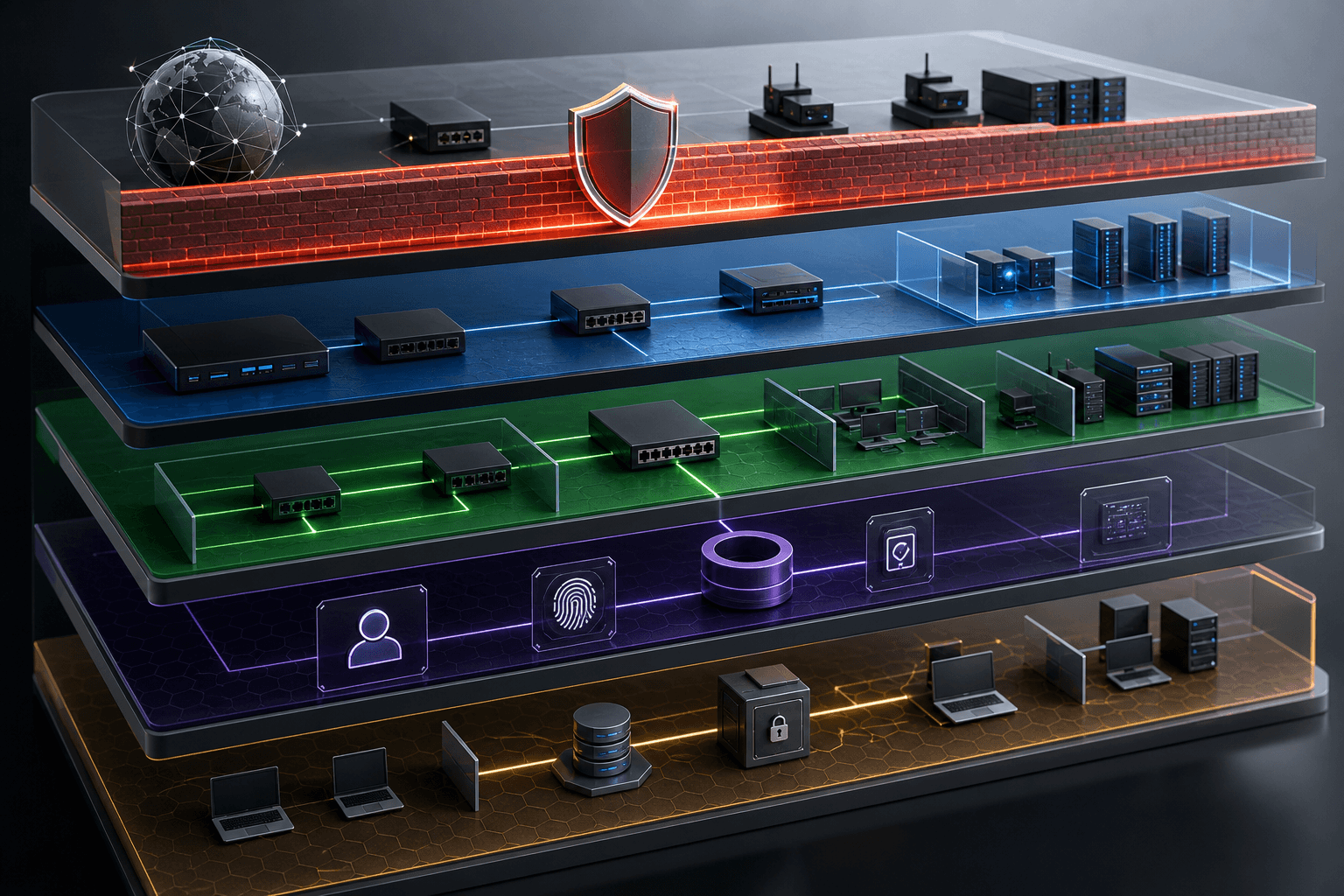
Security in 2026 is not optional and not a separate conversation from network management. The best managed network providers integrate security into every layer of their standard operating procedures.
Threat Detection and Firewall Management
Managed providers use SIEM (Security Information and Event Management) tools that analyse traffic patterns and identify anomalies at machine speed. A device communicating with a known malicious server or a user downloading terabytes of data abnormally triggers immediate alerts investigated by the provider's Security Operations Center (SOC).
Firewall management covers rule sets, traffic allowlists, regular configuration audits, and log monitoring. When new vulnerabilities are discovered, providers push patches and signature updates across your entire environment within hours. Many providers deploy Next-Generation Firewalls (NGFW) from Palo Alto Networks or Fortinet as standard.
Zero Trust and Secure Remote Access
Remote workers are permanent in most organisations. Managed providers implement Zero Trust Network Access (ZTNA), which verifies every user and every device before granting access — regardless of whether they are inside or outside the office network. This replaces legacy VPN with identity-based access limited to exactly the resources each user legitimately needs.
Security Compliance Monitoring
If your business operates under HIPAA, PCI DSS, GDPR, or ISO 27001 requirements, your network must meet specific security mandates. Managed providers understand these frameworks and maintain audit trails, enforce network segmentation, and produce compliance evidence — saving weeks of internal preparation before every audit.
7
Best Managed Network Solutions by Business Size
For Small Businesses: Affordable, Scalable, and Simple
Small businesses cannot spend like Fortune 500 companies, and they should not need to. Cloud-managed SD-WAN solutions are typically the most affordable entry point because they reduce hardware costs and simplify operations significantly. Monthly fees for a small office generally range from $500 to $2,000 depending on what is included.
The essential features for an SMB deployment:
For Large Enterprises: Multi-Location, Global, and SASE-Ready
Large enterprises face fundamentally different challenges: dozens or hundreds of locations, sophisticated attack surfaces, strict compliance mandates, and global performance requirements. Monthly costs for enterprise-grade managed network services typically range from $5,000 to $50,000 or more, depending on scale.
Enterprise-grade requirements include centralised management that can push policy globally in a single operation, advanced threat protection integrated with a full SOC, private backbone connectivity for consistent global performance, and direct cloud connect to AWS, Azure, and Google that bypasses the public internet entirely.
8
How to Choose the Right Managed Network Provider
Choosing a managed network provider is a structured process, not a vendor comparison exercise. Use this six-step framework to evaluate your options with confidence.
| Step | Action | What to Look For |
|---|---|---|
| 1. Assess requirements | Document locations, users, applications, downtime tolerance, compliance needs, and budget | Specific, written requirements you can share with every provider for apples-to-apples proposals |
| 2. Match solution type | Determine whether you need Managed LAN, WAN, SD-WAN, cloud-managed, or full SASE | Provider that has deep reference customers in your exact environment type |
| 3. Verify technical expertise | Check certifications: ISO 27001, SOC 2, Cisco CCNP/CCIE, Fortinet NSE, Juniper JNCIP | Number of certified engineers on staff — not just certificates on the wall |
| 4. Review SLA terms | Confirm uptime guarantees, response/resolution targets, service credit policies | Financial accountability when targets are missed — verbal promises mean nothing |
| 5. Check references | Speak with three current customers in similar industries | Honest answers about after-hours responsiveness, escalation quality, and what they would change |
| 6. Review exit terms | Confirm data portability, configuration hand-over, transition support, and termination penalties | Everything in writing — no reliance on verbal commitments |
Scorecard Criteria for Vendor Comparison
Build a weighted scorecard before you start talking to vendors. Recommended criteria and weightings for most organisations:
| Criterion | Suggested Weight | What to Measure |
|---|---|---|
| Technical fit with your requirements | 25% | Experience with your specific equipment and environment type |
| SLA guarantees and credit policies | 20% | Uptime %, response times, financial penalties for misses |
| Total cost of ownership (3 years) | 20% | Include hardware, licensing, support, and upgrade costs |
| References from similar customers | 15% | At least 3 verifiable references in your industry |
| Security certifications and posture | 10% | ISO 27001, SOC 2 Type II, breach response procedures |
| Support capabilities and hours | 10% | 24/7 coverage, escalation paths, primary contact quality |
9
Service Level Agreements — What to Demand

SLA terms define your entire relationship with a managed network provider. Do not skim this section of any contract.
Uptime Guarantees
Standard uptime guarantees range from 99.9% to 99.999%. The difference in actual downtime allowance is enormous:
Choose the level that matches your actual business risk. An e-commerce platform processing transactions needs 99.99% or higher. A small professional services office may operate acceptably at 99.9%.
Performance Benchmarks Beyond Uptime
The SLA should define quantified performance expectations — not just "network will be available" but specific thresholds for latency (maximum round-trip time between sites), packet loss (maximum percentage of dropped packets), jitter (maximum variation in delivery timing), and throughput (minimum bandwidth guaranteed). If the provider misses these benchmarks consistently, they should have a documented obligation to investigate and resolve the root cause.
10
Cost of Managed Network Solutions — Honest Numbers
Understanding the full cost picture helps you make an informed business case — and avoid surprises after you sign a contract.
Total Cost of Ownership — What to Include
The monthly subscription fee is not the full picture. A rigorous total cost of ownership calculation includes: hardware and software licensing costs, internal labour for any remaining network responsibilities, training for staff who interact with the managed service portal, downtime costs avoided (calculate your hourly revenue impact and multiply by incidents prevented), and hardware refresh costs over a 3-year period.
Industry data consistently shows that managed services have lower total cost of ownership than in-house management, even when the monthly fee appears higher than what you currently spend on internal staff. The delta closes quickly once you include recruitment costs, training investment, and the cost of a single major outage event.
11
Future Trends Shaping Managed Network Services in 2026
AI-Driven Network Operations (AIOps)
Artificial intelligence is moving from marketing language to operational reality in managed networking. Gartner predicts that by 2030, 50% of organisations will use agentic NetOps — AI agents that handle network tasks with minimal human involvement, creating self-healing networks that detect, diagnose, and resolve issues in seconds without a human in the loop.
Network Automation and Closed-Loop Systems
The most advanced providers already deploy closed-loop automation: the network detects an anomaly, correlates it with data from multiple sources, and implements a corrective action — all without human intervention. Routine tasks like configuration backups, compliance checks, and software updates are fully automated as a baseline expectation, not a premium feature.
SASE Adoption
Secure Access Service Edge (SASE) converges SD-WAN with cloud-delivered security services including Zero Trust Network Access (ZTNA), secure web gateways, cloud access security brokers (CASB), and next-generation firewalls into a single unified platform. The convergence simplifies management, reduces vendor sprawl, and provides consistent security policy regardless of where users and applications are located.
Predictive Analytics
Instead of reacting to problems, next-generation providers forecast them. A switch showing increasing error rates gets replaced proactively. A link approaching capacity saturation gets upgraded before users notice slowness. Predictive analytics transforms network management from a reactive fire-fighting exercise into a proactive business continuity function.
12
Common Mistakes When Selecting a Managed Network Provider
Learning from others' mistakes before signing a multi-year contract is significantly cheaper than learning from your own.
Choosing on Price Alone
The cheapest provider rarely delivers the best service. Low prices typically mean fewer NOC staff, older tooling, or weaker SLA commitments. A single major outage often costs more than 12 months of the savings from choosing the cheaper provider.
Skipping References
Marketing materials always look excellent. Talking to actual customers reveals response quality under pressure, communication style, and how the provider handles situations where they are at fault. Do not skip this step under time pressure.
Ignoring the Exit Plan
Every relationship ends eventually. If your contract does not include a clear data portability, configuration hand-over, and transition support clause, you may be locked into a provider you no longer want with no practical way out.
Overlooking Security Requirements
Your managed network provider has deep access to your infrastructure. Their security posture becomes your security posture. Verify ISO 27001 and SOC 2 certifications are current, not historical. Ask about their own breach notification process.
Misaligned Communication Expectations
Confirm reporting frequency, primary contact qualifications, escalation paths, and after-hours communication channels before signing. These gaps cause frustration more than any technical issue in the first 6 months of a managed service relationship.
Committing Full Scope Immediately
Start with a pilot covering one location or one network segment before committing your entire infrastructure. See how the provider actually performs, not how they promise to perform in a pre-sales environment.
Frequently Asked Questions
A Managed Network Service (MNS) is a model where an external IT Outsourcing Provider takes full operational responsibility for your network — including monitoring, maintenance, security, patch management, and incident response — under a contractual Service-Level Agreement (SLA) with defined uptime and response targets. The provider operates a 24/7 Network Operations Center (NOC) and handles everything from routine firmware updates to major incident response, while you pay a predictable monthly subscription.
Industry research consistently shows that businesses reduce total network operating costs by 20 to 50 percent when switching to a managed model. The savings come from reduced staffing costs, predictable subscription pricing that replaces unpredictable capital expenditure, fewer major outage incidents, and access to specialised expertise without the cost of hiring it. Most organisations reach payback within 6 to 12 months through downtime reduction alone.
Traditional WAN uses hardware routers and expensive MPLS circuits that treat all traffic identically — a critical video conference competes for bandwidth with a file backup. SD-WAN uses intelligent software to route traffic across multiple connection types including MPLS, broadband, and 4G/5G simultaneously, prioritising critical applications automatically. SD-WAN also enables centralised management from a single dashboard without on-site engineers at each location, which makes managed outsourcing practical even for organisations with dozens of sites.
Quality managed network providers offer uptime guarantees from 99.9% (approximately 8.8 hours of permitted downtime per year) to 99.999% (approximately 5 minutes per year). Critical-issue response times should be 15 to 30 minutes with resolution targets of 4 to 8 hours. SLAs should also define performance benchmarks for latency, packet loss, jitter, and throughput — not just uptime — with clearly documented service credits when any target is missed.
Pricing depends on the number of locations, users, equipment complexity, security requirements, and SLA targets chosen. Small businesses typically pay between $500 and $2,000 per month. Mid-market organisations with multiple sites pay $2,000 to $10,000 per month. Large enterprises typically pay $10,000 to $50,000 or more. Most providers use subscription-based models with hardware included through a Network-as-a-Service (NaaS) arrangement, eliminating large capital expenditure.
For organisational certifications look for ISO 27001 (information security management) and SOC 2 Type II (security, availability, and confidentiality controls). For technical staff, look for current certifications from Cisco (CCNP, CCIE), Juniper (JNCIP), Fortinet (NSE), and HPE Aruba Networking. For regulated industries, confirm PCI DSS, HIPAA, and GDPR compliance capabilities. Inclusion in the Gartner Magic Quadrant for Managed Network Services provides additional independent validation of provider quality.
Secure Access Service Edge (SASE) converges SD-WAN with cloud-delivered security services — including Zero Trust Network Access (ZTNA), secure web gateways, cloud access security brokers, and next-generation firewalls — into a single managed platform. Gartner predicts that by 2029, 75% of SD-WAN purchases will be part of a single-vendor SASE platform, making it the dominant architecture for outsourced IT network operations. Organisations evaluating managed SD-WAN today should ensure their chosen provider has a credible SASE roadmap.
Get Your Free Managed Network Audit from Webperts
Choosing the right managed network solution starts with understanding exactly what is happening inside your current environment. Webperts specialises in IT outsourcing solutions for businesses in Dubai and across the UAE — delivering localised, compliant, and performance-driven managed network services as a credible alternative to generic global providers.
The Webperts comprehensive network audit reveals performance bottlenecks you did not know existed, security vulnerabilities that could be exploited, configuration errors slowing you down, cost optimisation opportunities hiding in plain sight, and capacity issues before they cause outages. Every finding is delivered in plain language with clear, actionable recommendations — no jargon, no technical runaround.
Get Your Free Network Audit →Learn more about Webperts IT Outsourcing services