
You do not have to choose between writing for people and writing for AI. Content that serves both audiences follows the same core principles: clear headings, short paragraphs, front-loaded answers, and explicit relationships. AI Overviews now appear in over 50% of search results — meaning your content must satisfy human readers and AI answer engines simultaneously to remain visible.
This guide walks you through exactly how to structure, write, and test content that works brilliantly for both audiences — from heading hierarchies and paragraph length to semantic relationships and schema markup.
1
What Does Balancing Human Readability with LLM Extractability Mean?
Balancing human readability with LLM extractability means writing content that is easy for people to read and understand while also being easy for AI systems to scan, interpret, and pull key information from.
Think of it like designing a well-organised filing system. Your human reader opens a drawer and finds folders labelled clearly, with papers arranged logically inside. An AI system, on the other hand, can only read the folder labels and the first sentence of each document. It needs those labels to be precise and those opening sentences to contain the core message.
2
Why This Balance Is Important for Modern Content
This balance matters because the way people find information has changed fundamentally. More search queries now happen through AI-powered tools like ChatGPT, Google's AI Overviews, and other conversational search interfaces.
Here is what happens when you ignore this balance. Your content might read beautifully but confuse AI systems. They cannot find your main points, so they do not cite you in their answers. You lose organic traffic. Or the opposite — you write only for AI, stuffing your content with rigid structure that feels robotic. Human readers leave immediately. Neither scenario works. When you balance both, your content gets discovered, read, shared, and cited.
3
How Humans and AI Systems Consume Content Differently
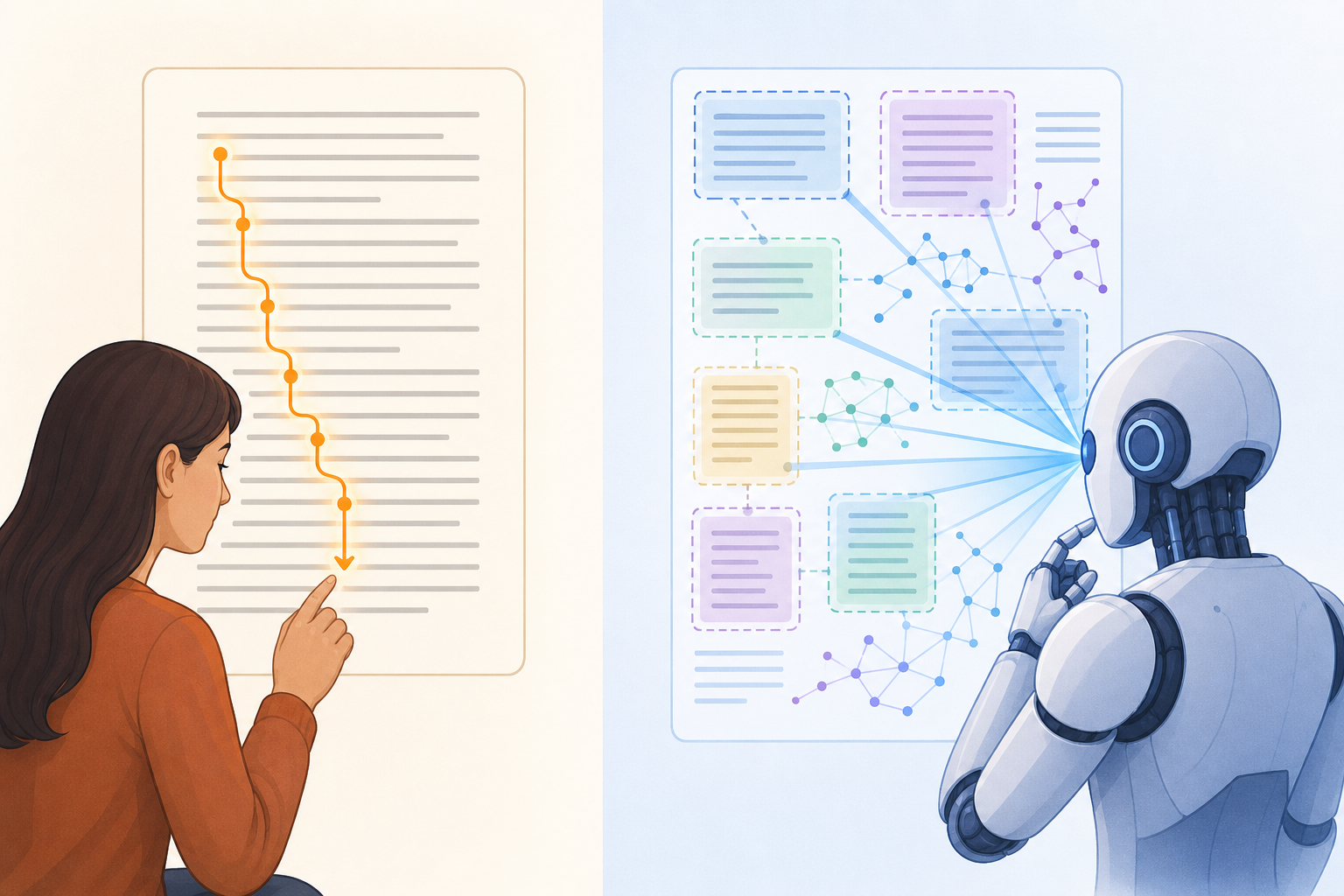
Humans read linearly. We start at the top and work our way down. We build context as we go. We understand jokes, metaphors, and implied meaning. We can handle ambiguity because our brains fill in the gaps naturally.
Large Language Models do not work that way at all.
When an AI system processes your content, it breaks the text into small pieces called chunks. It scans these chunks to find relevant information. It does not read sequentially. It jumps around, looking for patterns, headings, lists, and clear statements of fact.
How Humans Read
Sequential, top-to-bottom. Build context as they go. Understand implied meaning, metaphor, and pronoun references across paragraphs without confusion.
How LLMs Read
Non-sequential chunking. Scan for headings, lists, and explicit statements. Struggle with vague pronouns and references made several paragraphs earlier.
The Sweet Spot
Clear structure + natural language. Explicit relationships + conversational tone. Short paragraphs + real examples. Both audiences get exactly what they need.
Here is the key difference that affects your writing: humans understand context even when it is spread across paragraphs. AI systems often struggle with that because they have limited context windows. If you say "it" in one paragraph but the thing "it" refers to was mentioned three paragraphs earlier, an LLM may not connect those dots correctly.
4
What Content Characteristics Improve Human Readability
People love content that feels easy to digest. These are the characteristics that make writing a pleasure to read — the pillars of human readability.
Short Paragraphs
When a reader sees a wall of text, their brain gets tired just looking at it. Keep paragraphs to two or three sentences maximum. Sometimes one sentence is perfect. This improves reading flow and content accessibility.
Conversational Writing
Write as you talk. Use "you" and "I." Ask questions. Share small examples. This creates a connection that keeps people engaged and reading through to the end.
Clear, Specific Headings
Your headings should tell readers exactly what each section covers. Avoid clever or vague titles like "Digging Deeper." Use specific, helpful headings like "How to Structure Your Headings for AI Systems." This applies equally to human navigation and AI comprehension.
White Space
White space gives eyes a resting point. It makes the page feel lighter and less intimidating. This supports visual hierarchy and readable design — two things readers respond to positively without consciously noticing.
Bulleted and Numbered Lists
Lists break information into bite-sized pieces. They are perfect for steps, features, or any set of related items. They also happen to be exactly what AI systems look for when extracting structured information.
Real Examples
People learn by example. When you make a point, show it in action. This transforms abstract advice into something tangible and memorable. It also provides concrete context that AI systems can use to understand the application of a concept.
5
What Content Characteristics Improve LLM Extractability
AI systems need different features to extract information effectively. Here is what they look for to maximise extractability and support knowledge extraction.
Hierarchical Content Structure
AI relies on heading structure (H1, H2, H3) to understand how topics relate to each other. A clear hierarchy tells the system which topics are main and which are subtopics. When you skip heading levels — jumping from H2 to H4 — you create structural confusion for both humans and AI.
Short, Focused Content Sections
Each content section should cover one concept. This makes it easier for AI to perform content chunking correctly and pull the right information for specific search queries. One concept per section is the single most effective structural principle you can apply.
Direct Answers to Questions
When you answer a question, state the answer clearly and upfront. Do not bury it in a long paragraph. AI systems look for explicit question-and-answer patterns. These become extractable answers that power featured snippets and AI Overviews.
Consistent Terminology
Pick a term and stick with it. If you call something a "user account," do not later call it a "login profile." Content consistency reduces confusion for AI systems that rely on pattern recognition across chunks.
Explicit Semantic Relationships
Instead of saying "this helps with that," say "this heading structure helps AI systems navigate your content." Spell out the relationship. This improves machine interpretation and information retrieval accuracy — and it also makes your writing clearer for human readers.
6
How to Structure Content So Both Audiences Understand It
Start with a clear summary at the top of your page. Tell readers and AI what the page covers, who it is for, and what problem it solves. This gives both audiences immediate orientation and improves content discoverability.
Use a Logical Information Architecture
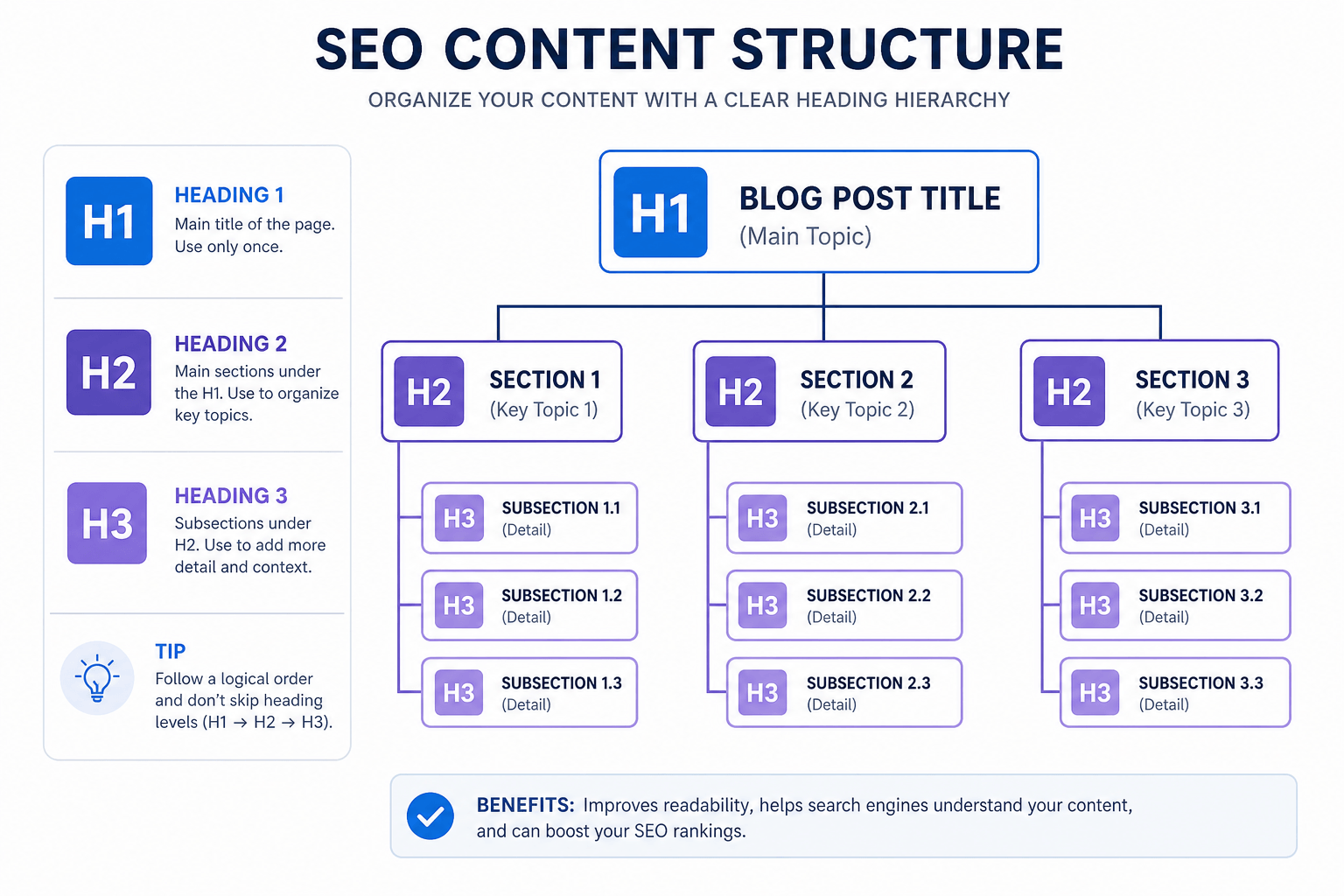
Use H2 headings for your main content sections. Use H3 headings for subtopics within those sections. Use H4 headings for even more specific points if needed. Never skip heading levels — going from H2 to H4 confuses everyone.
One Idea Per Paragraph
Break every content section into short paragraphs. Each paragraph should contain one idea. If you find yourself covering two concepts in one paragraph, split them apart. This is the essence of good content organisation — and it is the single most powerful thing you can do for AI extraction.
Front-Load Key Information
Place the most important information near the top of each content section. Do not make people or AI dig through paragraphs to find the main point. Lead with it. This improves information retrieval for AI and reduces bounce rate for humans.
7
How to Write Headings for Human Clarity and AI Comprehension
Headings and subheadings serve as signposts. They tell everyone — human or AI — where they are and what is coming next.
For humans, headings should be specific and useful. Instead of "Overview," write "What This Guide Covers." Instead of "Tips," write "Five Ways to Improve Your Headings." Specific headings help readers decide whether to read a section or skip it.
For AI, headings should follow a consistent topic hierarchy and use descriptive language. AI systems scan headings to understand your content structure. When you use clear, descriptive headings, the AI can map your content more accurately and match it to relevant search queries.
| Weak Heading | Strong Heading | Why It Works |
|---|---|---|
| Overview | What This Guide Covers | Specific, previews content, scannable for both audiences |
| Tips | Five Ways to Improve Your Headings | Quantified, expectation-setting, AI can count and extract items |
| Digging Deeper | How AI Systems Process Heading Hierarchies | Entity-specific, answerable, AI can extract as a direct answer |
| More Stuff | What Content Formats Are Easiest for LLMs to Summarise | Question format matches conversational search queries |
Here is an example of good heading practice in action:
- H1: How to Balance Human Readability with LLM Extractability
- H2: What Content Characteristics Improve Readability
- H3: Short Paragraphs and White Space
- H3: Conversational Writing and Real Examples
- H2: What Content Characteristics Improve Extractability
- H3: Hierarchical Content Hierarchy
- H3: Content Consistency
Notice how the hierarchy flows naturally. Each heading previews exactly what follows. No surprises for humans. No structural gaps for AI.
8
The Role of Semantic Organisation in Content Understanding
Semantic organisation means grouping related ideas in a way that makes logical sense. Think of it as creating a map of your topic where every concept sits near the concepts it connects to.
For human readers, semantic content makes writing feel coherent. You are not jumping randomly between unrelated ideas. You are building knowledge step by step, with each section preparing the reader for the next.
For AI systems, semantic organisation supports entity recognition and relationship mapping. When you group related concepts together, you help AI understand how those concepts connect. The system can see that "heading hierarchy" belongs with "content structure" and "AI comprehension."
9
How to Create Clear Topic Hierarchies
Start by outlining your content before you write. Ask yourself what the main topic is. Then ask what subtopics support that main topic. Then ask what specific points belong under each subtopic. This is how you build a strong topic hierarchy.
Here is a simple four-step process:
- Step 1 — Identify your core topic. Write this as your H1. It should answer the single most important question your page addresses.
- Step 2 — Brainstorm 5–7 main questions your reader has about this topic. Each question becomes a potential H2 section. This aligns your structure with search intent.
- Step 3 — Under each H2, list 3–5 specific answers or subtopics. These become your H3 headings. Each should be a specific, answerable point.
- Step 4 — Review your hierarchy. Does each H3 clearly belong under its H2? Does each H2 support the H1? If not, reorganise before you write a single paragraph.
This hierarchy serves both audiences. Humans get a logical flow. AI gets a clear structural map for content interpretation.
10
How to Present Entities, Attributes, and Relationships
Entities are the people, places, things, or concepts you write about. Attributes are their characteristics. Relationships are how entities connect. This entity-attribute-relationship model is the foundation of how AI systems build understanding from your content.
When You Introduce an Entity
Name it clearly and define it immediately. For example: "Content chunking is the practice of breaking information into smaller, digestible sections." The definition comes right after the entity name — no delay, no implied meaning.
When You Describe Attributes
Connect them directly to the entity. Instead of "It improves AI extraction," say "Content chunking improves AI extraction because it creates clear boundaries around information." The subject of the sentence should always be the entity, not a pronoun.
When You Explain Relationships
Be explicit. Say "Heading hierarchies help AI systems understand content structure." Do not imply the relationship. State it. This explicit style does not make your writing awkward — it makes it clearer for everyone. Humans appreciate the directness too.
11
How to Answer Questions That LLMs Can Easily Extract
Think about the actual search queries people type. Then answer those questions directly on your page. The key is to put the answer first, then add the explanation. This is the inverted pyramid style of information presentation.
How Long Should Paragraphs Be for AI-Friendly Content?
Answer (front-loaded): Keep paragraphs to one to three sentences for optimal AI extraction.
Explanation (follows): Longer paragraphs make it harder for AI systems to identify individual concepts and can lead to information being miscategorised. When you keep paragraphs short, each chunk contains one clear idea, which improves extraction accuracy.
Notice how the answer comes first. Supporting details follow. This pattern helps AI systems pull the direct extractable answer while still giving readers the full explanation they need. It is ideal for featured snippets and AI Overviews.
12
Writing Patterns That Help AI Identify Key Information
Several simple writing patterns make a significant difference for information extraction and passage retrieval. These are easy to implement — they just require attention during the editing process.
Pattern 1: Clear Factual Statements
"AI Overviews appear in over 50% of search results" is better than "You might see AI Overviews in many search results these days." Precision beats approximation for both clarity and extractability.
Pattern 2: Consistent Phrasing
Do not call it "chunking" in one paragraph and "segmentation" in the next. Consistent terminology across the entire article improves AI pattern recognition and human comprehension.
Pattern 3: Named Subjects
Instead of "This helps AI systems," write "This heading structure helps AI systems." Replacing vague pronouns with named entities is the single fastest way to improve extractability.
Pattern 4: Labelled Examples
Before giving an example, say "For example" or "Here is an illustration." This signals to AI that an example is coming — and makes the transition obvious for human readers too.
Pattern 5: Numbered Steps
When explaining how to do something, use a numbered list. Each step should be one action. Numbered lists signal process to AI systems and make instructions easy for humans to follow and remember.
13
How to Maintain Natural Language While Improving Machine Interpretation
You might worry that writing for AI will make your content sound robotic. That does not have to happen. The secret is to write for humans first, then edit for clarity.
Do not start with optimisation in mind. Start with a conversational draft. Write the way you speak. Use contractions. Ask questions. Share small stories.
Then go back and look for places where you can be more explicit without losing your voice. Here is what that editing looks like in practice:
| Before Editing | After Editing | What Changed |
|---|---|---|
| It helps with that | This heading structure helps AI systems navigate your content | Named the subject and the beneficiary explicitly |
| They process things differently | AI systems process information differently than humans do | Named the entity, removed vague pronoun |
| Do this | Follow these three steps to optimise your content structure | Quantified the action, named the outcome |
| This leads to better results | This leads to better AI extraction accuracy | Specified what kind of results and for whom |
Notice how the meaning stays the same. The natural language remains natural. You just removed ambiguity and made implicit semantic relationships explicit. That is the whole game.
14
Where to Place Important Answers — Beginning or Throughout?
Place important answers at the beginning of your content and at the beginning of each content section. This is called front-loading, and it works for both audiences.
Human readers often scan the top of a page to decide whether they want to stay. If you put your main answer in the first few paragraphs, they get immediate value. They trust you. They keep reading.
Here is the simple rule: if something is important, put it in the first sentence of its section. Do not bury the lead. This improves answer accuracy, information retrieval, and reader engagement simultaneously.
15
How to Write Concise Definitions Without Sacrificing Depth
Concise definitions are valuable for AI extraction. But you can pair them with deeper explanations immediately afterward. This maintains content depth while supporting knowledge extraction. The technique is called the definition sandwich.
- Step 1 — State the definition in one clear sentence. No preamble, no "well, it depends." Just the definition.
- Step 2 — Follow with a sentence or two of explanation. Add why the definition matters or how it works in practice.
- Step 3 — Add an example or use case. Concrete examples make the definition memorable for humans and give AI useful context for application.
Content Chunking — Definition Sandwich in Action
Definition: Content chunking is the practice of breaking information into smaller, focused sections.
Explanation: This technique helps both human readers and AI systems process content more easily by creating clear boundaries around individual concepts.
Example: A 2,000-word article divided into 8 sections of 250 words each is chunked. Each section has one heading and covers one subtopic. An AI scanning this article can quickly identify which section answers a specific question.
16
How to Present Facts, Statistics, and Evidence for Extraction
Put facts and statistics in their own sentences. Make them easy to spot. This is how AI systems identify data points and values for use in generated responses.
| ✗ Weak Format | ✓ Strong Format |
|---|---|
| Research shows that many search results, more than half actually, now include AI Overviews which rely on well-chunked content. | AI Overviews appear in over 50% of search results. |
| When you use proper page-level chunking, studies suggest accuracy tends to be higher on average for most retrieval systems. | Page-level chunking provides the highest average accuracy for AI retrieval systems across 3,000 documents tested. |
For multiple statistics or comparison points, use a table. Tables are excellent for AI extraction because they present structured, relational data clearly. Each cell contains a specific value connected to its row and column headers.
| Content Metric | Benchmark |
|---|---|
| Search results showing AI Overviews | Over 50% |
| Pages using proper heading hierarchy | ~35% |
| Users who scan before reading | ~80% |
| Optimal paragraph length for AI extraction | 1–3 sentences |
| Optimal reading level for online content | Grade 8–10 |
17
How Lists, Tables, and Structured Formats Improve Extractability
Structured formats tell AI exactly what kind of information it is looking at. This is a core principle of structured writing and one of the most powerful levers you have for improving extractability.
Numbered Lists
Signal a process or sequence. Each item relates to the others in a specific order. AI systems can extract the full list as a process or pull individual steps as needed. Use for how-to instructions, step-by-step guides, and ordered processes.
Bulleted Lists
Signal a set of related but unordered items. AI treats each bullet as a separate chunk of related information. Use for features, characteristics, tips, and any collection of related but non-sequential items.
Tables
Signal relational data. Each cell contains a specific value connected to row and column headers. AI can extract individual cells or entire rows. Use for comparisons, benchmarks, and structured data sets.
Fenced Code Blocks
Signal that the enclosed content is code, not prose. This prevents AI from misinterpreting code examples as regular sentences. Always use proper code formatting for technical content.
18
How to Optimise Paragraphs for Both Engagement and Information Retrieval
Keep paragraphs short and single-focused. One paragraph should contain one idea. This is the single most effective content optimisation you can make — and it improves both human engagement and AI extraction simultaneously.
Dense Paragraph vs Chunked Paragraphs
Before (dense): Content chunking is the practice of breaking information into smaller digestible sections that allow both human readers and search engines to better process and understand your content. This technique reduces cognitive load because your brain can only hold about seven pieces of information at once, according to research. Chunking also improves SEO because search engines can better identify relevant sections for different search queries.
After (chunked):
Content chunking is the practice of breaking information into smaller, digestible sections. This helps both human readers and search engines process your content.
Your brain can only hold about seven pieces of information at once. Chunking reduces cognitive load by respecting this natural limit.
Search engines also benefit from chunking. They can identify relevant sections for different search queries more easily.
19
How to Avoid Ambiguity That Confuses Readers and AI Systems
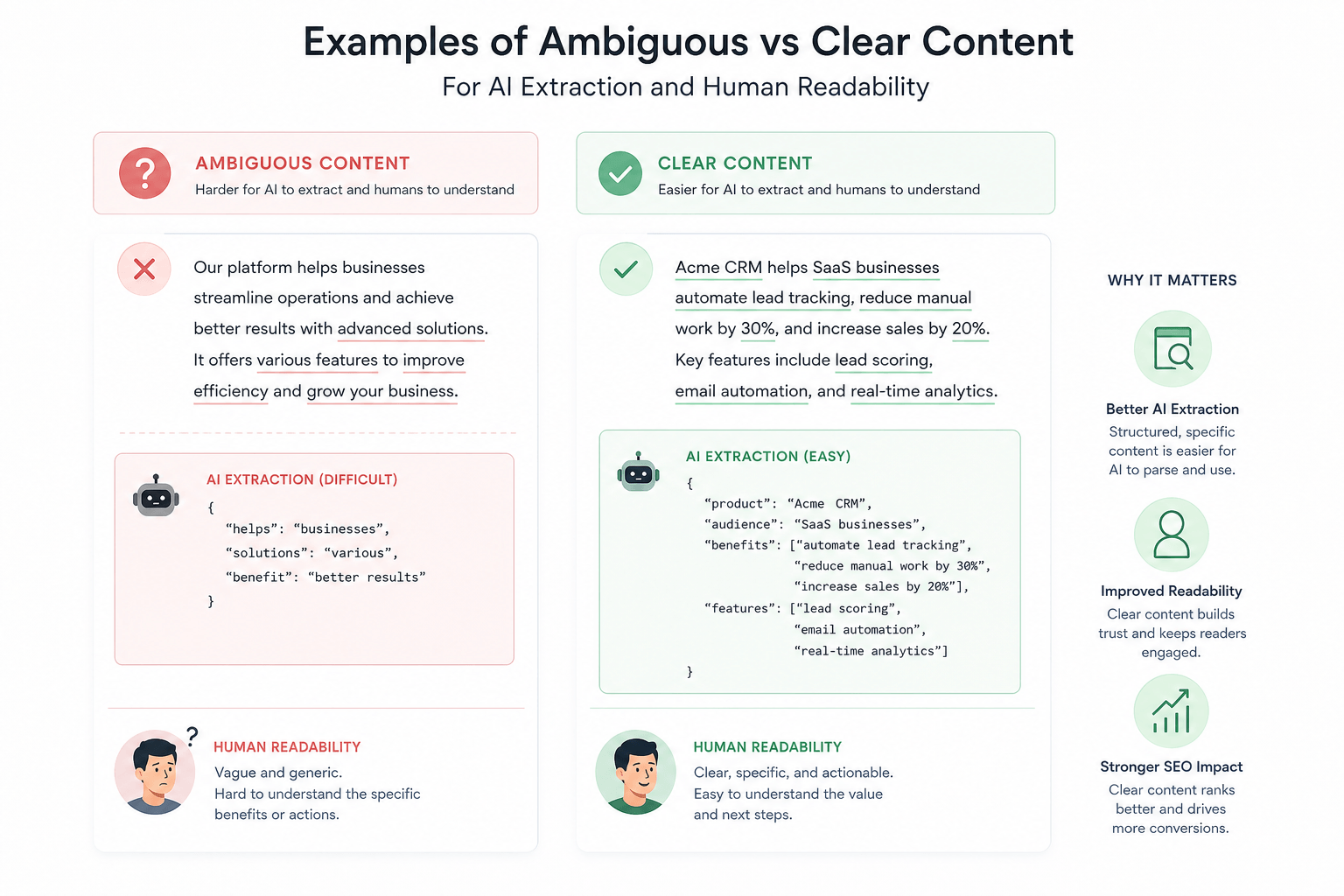
Ambiguity happens when a word or phrase could mean multiple things. Humans often resolve ambiguity through context. AI systems frequently miss these contextual signals and default to incorrect interpretations.
Here are the most common ambiguous patterns to avoid and what to replace them with:
20
Topical Authority: How It Improves Both Readability and Extractability
Topical authority means covering a subject comprehensively. You do not just write one article. You write several articles that explore different angles of the same topic.
For human readers, topical authority builds trust. When someone sees that you have written extensively about a subject, they believe you know what you are talking about. This signals expertise and authoritativeness — two of the four EEAT pillars that Google's quality raters assess.
For AI systems, topical authority signals topic relevance. When you cover a topic comprehensively, your site becomes a go-to source for that subject. AI systems are more likely to cite your content because you have demonstrated content depth across multiple angles of the same subject.
21
Common Conflicts Between Readability and Extractability — and How to Resolve Them
Most conflicts between human readability and AI extractability are not as significant as you might expect. Here are the ones that come up most often and how to resolve them.
Short Paragraphs vs Flowing Prose
Some writers feel short paragraphs feel choppy. But readers actually prefer short paragraphs online — they scan more easily. This is usually a stylistic preference, not a real conflict. Readers and AI agree: shorter is better.
Explicit Statements vs Elegant Writing
Explicit writing can feel repetitive. But be explicit in your headings and topic sentences while allowing more flow in your supporting details. The structured sections provide facts; the conversational sections provide context.
Structured Formats vs Narrative Flow
Lists and tables interrupt the narrative. Use them for key information. Save narrative flow for explanations and examples. Structure for facts, narrative for context. Both audiences get what they need.
Front-Loading vs Building Suspense
Online content should not build suspense. Front-load your answers. If you want to build engagement, use examples and stories after you state the main point. Never make readers or AI search for the answer.
22
Schema Markup for Human and AI Content Comprehension
Schema markup is code that helps search engines understand your content. It is like adding labels that say "this is an article," "this is the author," "this is a frequently asked question."
Schema-aligned writing means structuring your content to work well with schema markup. Research shows that pages with complete, well-structured schema are more likely to appear in AI Overviews. The most impactful schema types for content articles are:
Article + Author + Organization
Establishes EEAT signals. Includes author name, job title, publisher name, logo, publication date, and modified date. Required fields must all be populated — partial schema provides less benefit than complete schema.
FAQPage
Marks up question-and-answer sections so AI can extract them as direct answers. Each FAQ entry that matches a search query becomes a candidate for AI Overviews and featured snippets.
HowTo
Marks up step-by-step instructions with position, name, and text for each step. AI systems extract HowTo steps for voice search, AI Overviews, and instructional answer cards.
BreadcrumbList
Marks up the page's position in the site hierarchy. Helps AI understand the relationship between pages and improves how your site structure is displayed in search results.
23
How to Test Whether Content Works for Both Humans and AI
Run a simple two-step test before publishing any piece of content. This combines human testing and AI testing to verify both readability and extractability simultaneously.
- Step 1 — Human testing: Ask someone who is not an expert to read your content. Give them three minutes. Then ask them to tell you the three most important points. If they cannot identify your key information, your content structure needs work.
- Step 2 — AI testing: Paste your content into a free AI tool like Claude or ChatGPT. Ask it to summarise the content in three bullet points. Compare the AI summary to your intended key messages. If they do not match, your extractability needs improvement.
Repeat this process until both tests pass consistently. This simple feedback loop will dramatically improve your content quality over time. It verifies answer accuracy from both the human perspective and the AI perspective.
| Tool | What It Measures | Target |
|---|---|---|
| Hemingway App | Sentence length, passive voice, complexity | Grade 8–10 reading level |
| Grammarly | Grammar, readability, tone consistency | Clear, direct score above 70 |
| Yoast SEO | Paragraph length, transition words, heading distribution | All green lights |
| ChatGPT / Claude | AI extractability, summary accuracy, key message identification | Summary matches intended messages |
| Hotjar / Crazy Egg | Scroll depth, engagement, bounce rate | Low bounce, high dwell time |
24
What an Ideal Human-Readable and LLM-Friendly Content Section Looks Like
Here is an example that brings everything together. Notice the elements: clear heading, short paragraphs, a definition upfront, a numbered list, bolded key terms, a labelled example, and a statistic in its own sentence.
How Content Chunking Improves AI Extraction
Content chunking is the practice of breaking information into smaller, focused sections. This technique directly improves how AI systems process your content.
AI systems extract information in three ways that chunking supports:
- Passage retrieval. AI pulls specific sections that answer user queries. Chunking creates clear boundaries around each passage.
- Entity recognition. AI identifies key entities. Chunking isolates entities in their own sections.
- Relationship mapping. AI connects related concepts. Chunking groups related ideas together.
Example. A 2,000-word article divided into 8 sections of 250 words each is chunked. Each section has one heading and covers one subtopic. An AI scanning this article can quickly identify which section answers a specific question.
Research shows that page-level chunking provides the highest average accuracy for AI retrieval systems across 3,000 documents.
25
Content Readability & Extractability: Quick-Reference Checklist
Use this checklist to evaluate any piece of content before publishing. Click each item to mark it complete.
26
Key Statistics: Human Readability & LLM Extractability
Frequently Asked Questions
Balancing human readability with LLM extractability means writing content that is easy for people to read and understand while also being easy for AI systems to scan, interpret, and pull key information from. You do not have to choose between the two — the same structural principles that make content easy for humans to navigate also make it easier for AI to extract and cite.
Humans read linearly, build context progressively, and understand implied meaning and metaphor. AI systems break text into chunks, scan for headings and patterns, and struggle with pronouns or cross-paragraph references. AI has a limited context window, so information that seems obvious to a human reader may be missed entirely by an AI if it is not stated explicitly.
Keep paragraphs to one to three sentences for optimal AI extraction. Each paragraph should cover exactly one idea. When paragraphs contain multiple concepts, AI systems may miscategorise or miss information during chunking. Short paragraphs also improve human scanability, making this the single most impactful formatting change you can make for both audiences.
Yes. AI Overviews now appear in over 50% of search results. Pages with clear heading hierarchies, front-loaded answers, explicit semantic relationships, and structured formats like lists and tables are significantly more likely to be cited in AI-generated responses. Schema markup — particularly FAQPage and Article schemas — further improves your chances of appearing in AI Overviews.
The most impactful schema types for blog content and guides are Article (with Author and Organization), FAQPage, HowTo, and BreadcrumbList. All required fields should be populated — partial schema provides less benefit than complete schema. Always minify your JSON-LD schema to maintain page load speed and avoid penalising your Core Web Vitals score.
Run a two-step test. First, ask a non-expert to read your content for three minutes, then identify the three most important points without looking. If they cannot, your structure needs work. Second, paste your content into an AI tool like Claude or ChatGPT and ask for a three-bullet summary. Compare it to your intended key messages. If the AI missed something important, your extractability needs improvement. Repeat until both tests pass.
27
Final Thoughts
Balancing human readability with LLM extractability is not a new discipline. It is clear writing, applied consistently. The same principles that made content easy to read in 2010 — specific headings, short paragraphs, direct answers, logical structure — are exactly what AI systems need to understand and cite content in 2026.
The writers and businesses that will win in AI-driven search are not those who learn to game a new algorithm. They are the ones who commit to writing clearly for humans first, then editing rigorously for explicitness.
Every piece of content you publish is either easy for AI to extract and cite, or it is not. The difference is structure, clarity, and consistency. Apply the principles in this guide to every article, and your content will work for both audiences simultaneously — attracting the search visibility and trust your work deserves.
Is Your Content Visible to AI Search Engines?
The Webperts team specialises in comprehensive content audits that evaluate your website for both human readability and LLM extractability. They analyse your heading hierarchy, content chunking, entity clarity, schema markup, and overall information architecture — then provide clear, actionable recommendations you can implement immediately.
Get Your Free Content Audit →Explore SEO & Content Services