
Watching your website traffic numbers go down can feel unsettling. You put so much work into creating content, building links, and optimizing pages. Then one day, you open your analytics dashboard and notice the line is moving in the wrong direction.
Here is some good news. Traffic declines are often fixable. Search engines update their rules. Competitors improve their sites. Your own website might have developed some issues behind the scenes. The key is knowing which SEO strategy services actually help you recover lost ground.
In this guide, you will learn exactly how to diagnose your traffic drop and which professional Search Engine Optimization Services can turn things around. A solid Traffic Recovery Strategy combines multiple tactics, and we will explore each one in detail.
How Can I See Traffic on My Website?
Before fixing a traffic problem, you need to know where you stand. Several free and paid tools show you how many people visit your site and where they come from, giving you a clear view of your Website Performance.
Google Search Console
This free tool from Google is your best starting point. It shows which Search Queries bring people to your site, how often your pages appear in Search Engine Results Pages (SERPs), and your average Click-Through Rate (CTR). You can see exactly when traffic started dropping and which Landing Pages were affected.
Google Analytics
Google Analytics provides deeper insights into User Engagement Metrics. Reports show traffic by source — Organic Search, social media, or direct visits — so you can identify whether the decline affects one channel or all of them. To find page-level data, navigate to Reports > Engagement > Pages and screens.
Ahrefs Webmaster Tools
Ahrefs Webmaster Tools offers a free option that protects visitor privacy because it does not use cookies. It tracks unique visitors, total visits, views per visit, and even breaks down traffic from AI search tools like ChatGPT and Perplexity.
WordPress Traffic Plugins at a Glance
| Tool | Best For | Key Features |
|---|---|---|
| Jetpack | Built-in stats | Shows top posts, search terms, referring sites |
| MonsterInsights | Google Analytics in WordPress | Displays Analytics reports inside your dashboard |
| Site Kit by Google | Connecting Google tools | Links Analytics, Search Console, PageSpeed |
| WP Statistics | Privacy-focused tracking | Stores data locally, no third-party sharing |
Why Is My Website Traffic Declining?
Organic Traffic drops rarely happen without reason. Something changed. The challenge is identifying whether the problem is technical, content-related, or competitive, and then improving your Search Visibility accordingly.
Common Causes of Organic Traffic Loss
- Google Algorithm Updates: Google rolls out thousands of changes each year. If your traffic dropped around a known update date, that is likely the cause.
- Technical issues: Slow-loading pages, crawl errors, broken links, or indexing problems can all hurt your Organic Visibility. A site Google cannot crawl properly will not rank well.
- Content that aged poorly: What worked two years ago may feel outdated now. If your competitors updated their content while yours sat unchanged, they likely moved ahead.
- Lost backlinks: When other websites remove links to your content, you lose authority signals. A sudden drop in quality backlinks can hurt Organic Rankings significantly.
- Keyword cannibalization: Multiple pages targeting the same keyword confuse Search Engines about which page to show, and sometimes neither ranks well.
- Search Intent shifts: The way people search for information evolves. If your content no longer matches what searchers want, traffic will decline.
How to Identify Whether the Decline Is Technical, Content-Related, or Competitive
A systematic approach helps you pinpoint the root cause:
- Check Google Search Console first. Compare date ranges in the Performance report. Filter by page to see which URLs lost traffic. Filter by query to see which keywords dropped.
- Run a technical crawl. Tools like Ahrefs Site Audit or Screaming Frog scan your entire website for Broken Links, Redirect Chains, and mobile usability problems.
- Review content freshness. Go through your top 20 pages by traffic. When were they last updated? Are there new statistics or insights you could add?
- Study your competitors. Search for your main keywords and see who ranks above you now. What are they doing that you are not?
Which Traffic Sources Are Declining the Most?
Open Google Analytics and look at the Traffic Acquisition report. This shows performance broken down by channel: Organic Search, Direct, Referral, Social, Email, and Paid.
- If Organic Search is the only channel dropping, the issue relates to your SEO.
- If all channels are dropping, you might have a broader problem like slow loading times or a security issue.
- If referral traffic dropped significantly, you may have lost Backlinks. Use Ahrefs or SEMrush to check which links disappeared.
How Can an SEO Audit Reveal the Cause of Traffic Loss?
An SEO Audit is like a physical exam for your website. It reveals what is working, what is broken, and what needs immediate attention. Professional Technical SEO Audit and Content Audit services examine dozens of factors that affect Search Visibility.
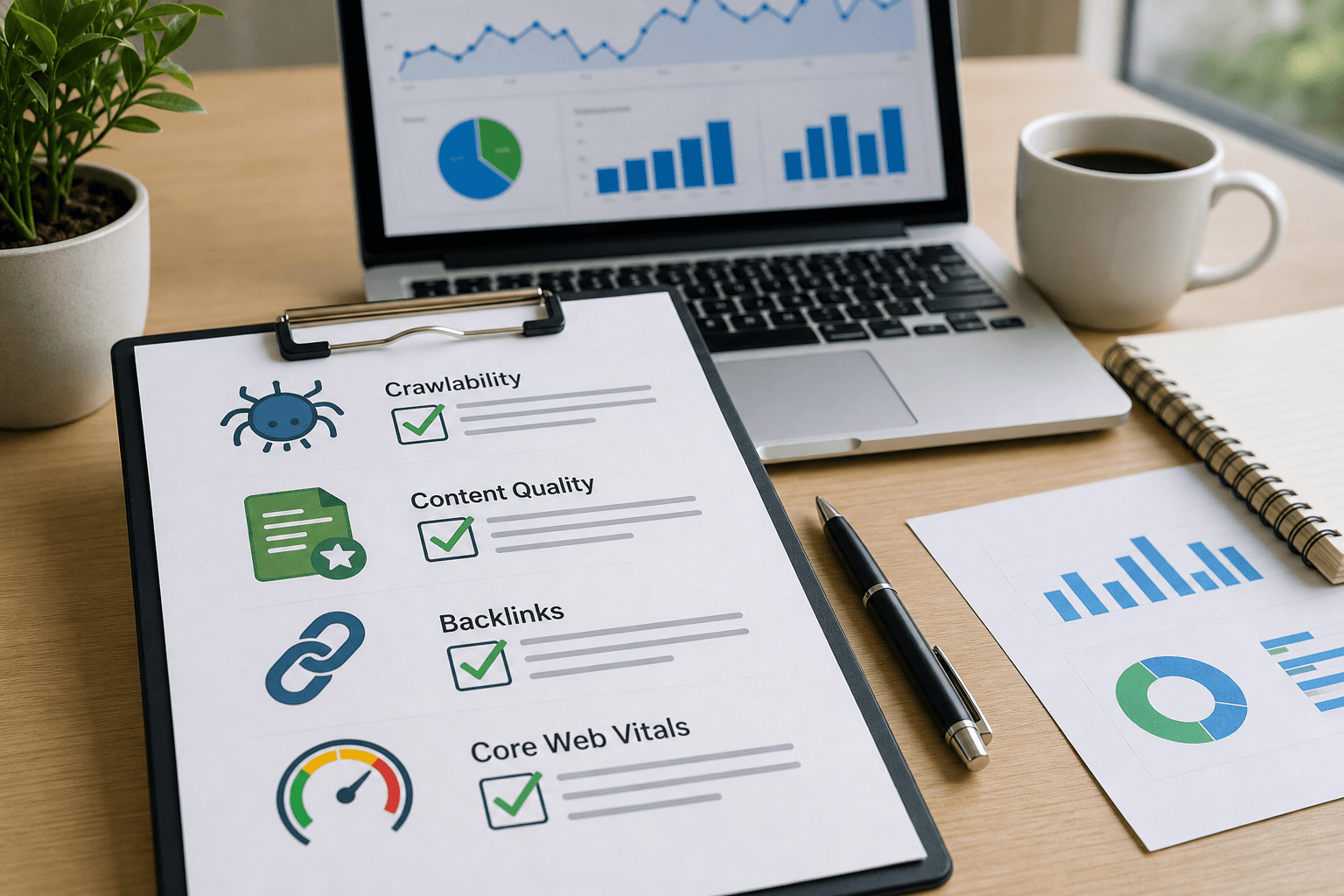
SEO Audit Areas to Prioritize First
A good Website Audit prioritizes issues by their potential impact. The most critical areas include:
- Crawlability and indexability. Can Search Engine Bots actually find and read your pages? The audit checks your Robots.txt file, XML Sitemap, and Crawl Budget. It identifies pages that Google cannot access or chooses not to index using the Index Coverage Report.
- Site architecture. A flat structure where every page is a few clicks from the homepage helps Search Engines understand your Website Architecture and distribute authority efficiently.
- On-page elements. Meta Titles, Meta Descriptions, Heading Tags, image Alt Text, and Internal Linking Structure are all examined for optimization opportunities.
- Content quality. The Content Audit evaluates whether your On-Page Content matches Search Intent, provides sufficient depth, and includes appropriate keywords naturally.
- Backlink profile. A Backlink Audit identifies Toxic Backlinks that might be hurting your rankings alongside valuable links worth protecting.
- Page Experience Signals. Google measures loading performance, interactivity, and visual stability through Core Web Vitals. Poor scores can hurt rankings, especially on mobile devices.
- Structured Data. The audit checks for Schema Markup implementation. These help Search Engines understand content context and enable Rich Results.
How Technical SEO Issues Affect Rankings and Traffic
Technical SEO issues create friction. They make it harder for Search Engines to discover your content and harder for users to access it.
📈 Real-world result: Factory Direct Flooring experienced a significant traffic drop traced to multiple technical problems — indexation issues, platform errors, and failing category pages. Once resolved, Organic Traffic increased by 81% and revenue grew by the same amount.
Common technical issues include:
- Slow page speed — a page loading in 3 seconds versus 1 second loses up to half its visitors
- Broken Links and Crawl Errors that waste Crawl Budget
- Duplicate Content across multiple URLs, often caused by improper Canonical Tags
- JavaScript SEO problems where Search Engine Bots cannot render content properly
- HTTPS Security issues or mixed content warnings
What SEO Strategy Services Are Most Effective for Recovering Lost Traffic?
Recovering from a traffic decline requires a strategic approach, not random fixes. The best Search Engine Optimization Services focus on diagnosing root causes first, then applying targeted solutions through a clear SEO Roadmap.
SEO Services That Directly Address Ranking Declines
- Technical SEO Services fix crawlability, indexability, speed, and mobile issues. These are often the fastest path to recovery because technical problems directly block Search Engine Bots from accessing your content.
- Content Optimization Services update outdated pages, fill Content Gaps, and better match Search Intent. Updating 85 priority pages with fresh, intent-led content helped one site increase Search Visibility by 53%.
- Keyword Strategy Services identify which terms you lost Organic Rankings for and find new opportunities, including fixing Keyword Cannibalization and targeting Long-Tail Keywords.
- Link Reclamation Services find and restore lost Backlinks while building new authority signals. Quality links remain one of the strongest ranking factors.
- Competitor Analysis Services reveal what other sites in your space are doing successfully, so you can learn from their wins without copying them directly.
How Does a Customized SEO Recovery Strategy Work?
Cookie-cutter approaches rarely work for Traffic Recovery. Each website has unique issues that need specific solutions. A good SEO Recovery Strategy is built on understanding your Website Performance data.
Deep-Dive Audit
The SEO Agency or SEO Consultant examines your technical setup, content quality, backlink profile, and competitive landscape. They identify exactly what changed when your traffic dropped.
Prioritized Action Plan
Not every issue matters equally. A good SEO Roadmap tackles high-impact problems first. Technical blockers usually come before content updates because fixing access issues helps everything else work better.
Quick Wins Implementation
Updating Meta Titles and Meta Descriptions, fixing Broken Links, and improving site speed can show movement within weeks of implementation.
Strategic Initiatives
Deeper work like restructuring your Website Architecture, developing Topic Clusters, and building authority through Digital PR takes longer but produces sustainable Organic Growth.
Measurement and Adjustment
The strategy adapts based on what the data shows. Monthly reporting covers Organic Traffic, Ranking Keywords, CTR, Core Web Vitals scores, and backlink growth.
How Can Technical SEO Services Help Restore Organic Traffic?
Technical SEO forms the foundation of Search Visibility. Without solid technical health, even great content struggles to rank. Technical SEO Services focus on making your site easy for Search Engines to discover, crawl, understand, and index.
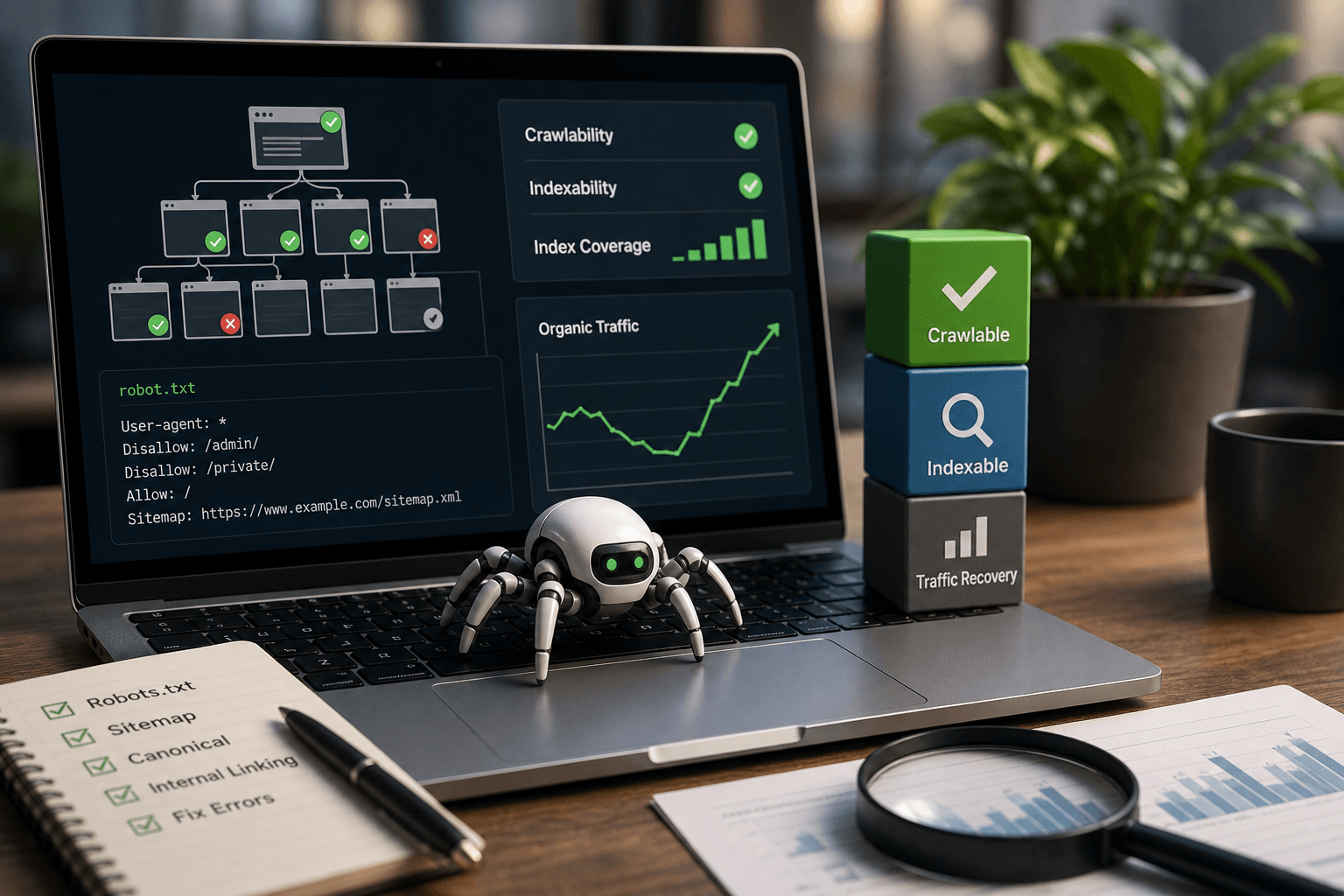
Crawlability and Indexability Issues
Think of Crawlability as whether Search Engine Bots can find your front door. Indexability is whether they can read what is inside. Common crawlability issues include:
- Robots.txt blocking important pages — sometimes configured too aggressively, blocking whole sections of your site
- Noindex tags on valuable content — accidentally adding them to important pages removes those pages from search entirely
- Orphan pages — pages with no internal links pointing to them are invisible to crawlers
- Thin or broken sitemaps — your XML Sitemap should list all important URLs; if it contains errors, crawlers miss content
Site Speed Optimization
Speed matters more than many site owners realize. Google has confirmed that Site Speed Optimization is a ranking factor for both desktop and mobile searches. As load times increase, Bounce Rate rises and conversions fall. Technical SEO Services address speed through:
- Image optimization — modern formats like WebP load faster than JPEG or PNG
- Code minification — removing unnecessary characters from HTML, CSS, and JavaScript makes files smaller
- Browser caching — storing static files on visitors' devices means they do not need to download everything on each visit
- Content delivery networks (CDNs) — distributing your content across global servers so visitors download from a nearby location
- Server optimization — moving to better hosting or optimizing Server Response Time reduces delays
Core Web Vitals and Rankings
Core Web Vitals are Google-specific metrics measuring User Experience (UX). Pages that fail these benchmarks may rank lower, especially in mobile search results.
| Metric | What It Measures | Good Score |
|---|---|---|
| Largest Contentful Paint (LCP) | Loading speed of main content | 2.5 seconds or faster |
| Interaction to Next Paint (INP) | Responsiveness to clicks and taps | 200 ms or less |
| Cumulative Layout Shift (CLS) | Visual stability during load | 0.1 or less |
Mobile Usability
More than half of all web traffic comes from mobile devices. Google primarily uses the mobile version of your site for ranking and indexing through mobile-first indexing. Common mobile issues include text too small to read, clickable elements too close together, viewport not configured, and fonts that do not load properly. Technical SEO Services test your site across multiple devices and screen sizes to ensure a seamless experience for every visitor.
How Can Content Optimization Services Recover Lost Rankings?
Content Optimization is what searchers actually want. Technical SEO gets them to your door, but On-Page Content convinces them to stay. Content Optimization Services breathe new life into pages that have lost their ranking power by improving Content Relevance and User Intent alignment.
Which Pages Should Be Updated First?
Prioritization helps you get the biggest impact from your effort. Start with:
- Pages ranking in positions 4 through 15. These are close to the first page. Small improvements can push them up.
- Pages with declining traffic but steady impressions. If Impressions hold but Organic Clicks drop, your Meta Titles and Meta Descriptions need work. If both dropped, the On-Page Content itself needs updating.
- Your money pages. Product pages, service pages, and key conversion points deserve priority attention.
- Pages with strong backlinks but poor content. If other sites link to a page, improving its content maximizes the value of those links.
How Outdated Content Affects Search Visibility
Search Engines want to show users the most current, accurate information. Specific problems with outdated content include:
- Old statistics — data from several years ago may no longer be accurate or relevant
- Deprecated information — software versions, product availability, pricing, and company details change over time
- Broken links and images — external resources disappear and images get moved or deleted
- Missing new developments — industries evolve and content that does not reflect current realities feels incomplete
Content Gaps: What to Identify and Fill
Content Gaps are topics your competitors cover that you do not. Common gaps include missing subtopics that answer related questions, poor formatting (long blocks of text versus scannable bullet points and tables), lack of visuals, no internal links to related content, and weak conclusions or calls to action. Content Optimization Services perform Content Gap Analysis comparing your content to top-ranking pages and create briefs for updates that close those gaps.
Search Intent Optimization
Search Intent is the reason behind a search query. The four main types are:
| Intent Type | What the Searcher Wants | Example Query |
|---|---|---|
| Informational | Learn something | "how to fix a leaky faucet" |
| Navigational | Find a specific website | "Facebook login" |
| Commercial | Research before purchase | "best running shoes" |
| Transactional | Complete a purchase | "buy iPhone 15" |
If your On-Page Content does not match the User Intent behind a keyword, it will not rank well. Content Optimization Services analyze the SERPs for each target keyword, study what type of content currently ranks, and then align your content with that observed User Intent. Content Pruning is also used to remove Thin Content or pages that no longer serve a purpose, improving your overall Topical Authority.
How Can Keyword Strategy Services Improve Traffic Recovery?
A smart Keyword Strategy helps you understand which Primary Keywords and Secondary Keywords to target, which to fix, and which to leave behind based on Search Demand.
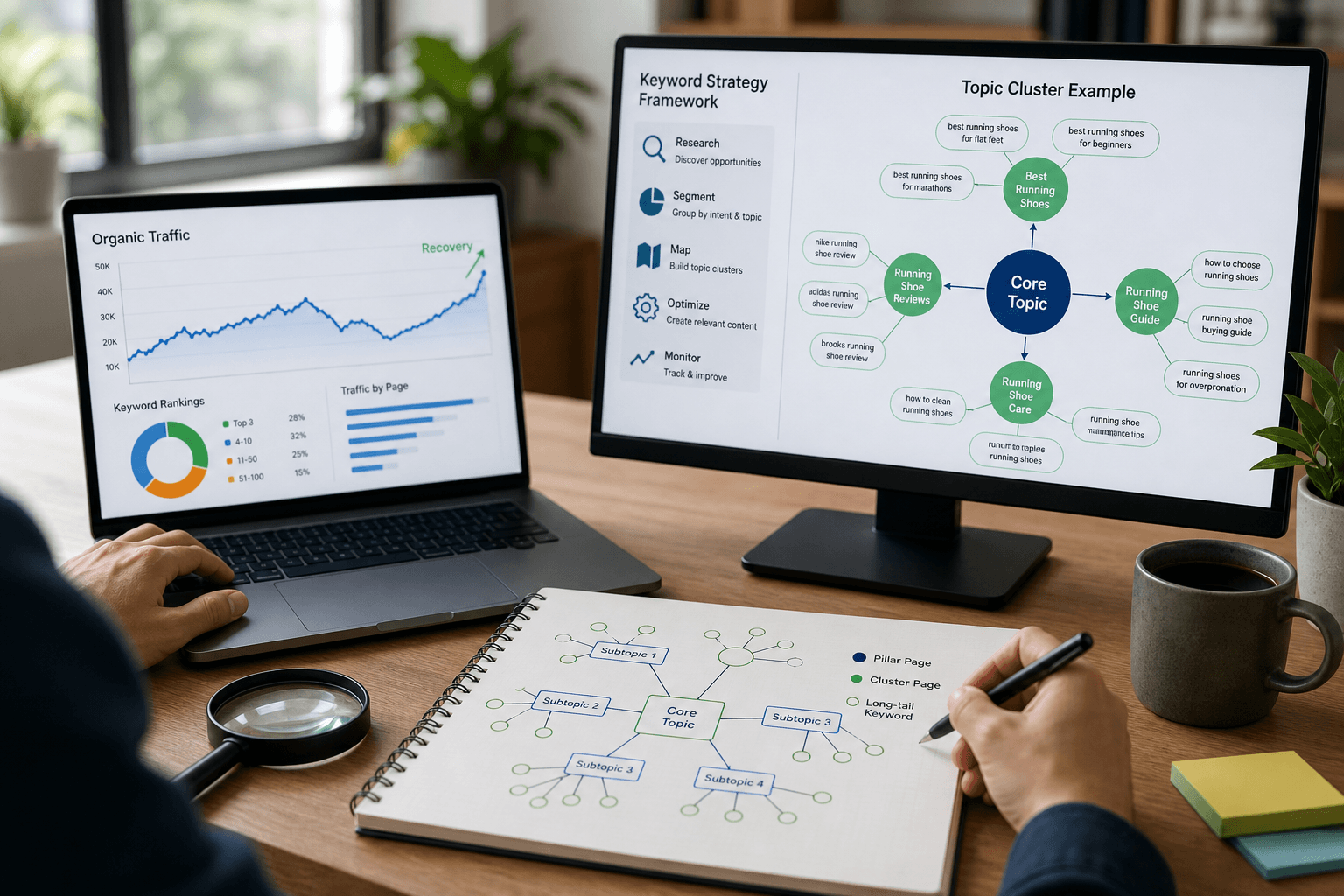
Identifying Keywords That Lost Rankings
Open Google Search Console's Performance report. Set the date range to compare the last three months against the previous three months. Sort by the change in position or Organic Clicks to see which Search Queries lost ground. Common reasons for keyword declines include increased competition, Google Algorithm Updates, content staleness, and technical issues.
How to Fix Keyword Cannibalization
Signs of cannibalization include your site appearing twice in SERPs for a query (but both pages ranking lower than one strong page would), the page Google shows changing frequently, and multiple pages with very similar Meta Titles and Meta Descriptions.
To fix Keyword Cannibalization:
- Add Canonical Tags pointing from the weaker pages to your chosen authoritative page
- Rewrite weaker pages to target different, related Semantic Keywords
- Consolidate content by merging similar pages and redirecting old URLs
- Adjust Internal Linking Structure to point to your chosen page using relevant anchor text
Long-Tail Keyword Opportunities
Long-Tail Keywords are longer, more specific phrases. They often have lower Search Volume but higher conversion rates and lower Keyword Difficulty. Benefits include lower competition (most sites fight over head terms, leaving long-tail opportunities open), clearer intent, and higher conversion potential. Keyword Strategy Services identify phrases with decent Search Volume but low Keyword Difficulty — these often provide the fastest path to traffic recovery.
Topic Clusters and Pillar Pages
Topic Clusters organize content around Pillar Pages. A pillar page broadly covers a main topic. Cluster Pages dive deep into specific subtopics, all linking back to the pillar page through Content Silos. This structure helps Search Engines understand your Topical Authority and distributes authority throughout the cluster.
| Pillar Page | Cluster Pages |
|---|---|
| Email Marketing Complete Guide | How to Build an Email List |
| Email Personalization Strategies | |
| Best Email Automation Workflows | |
| Email Analytics and Metrics | |
| GDPR Compliance for Email |
How Do Competitor Analysis Services Help Recover Traffic?
Your traffic did not disappear. It went somewhere else. Competitor Analysis Services identify exactly where your visitors went and why by analyzing SEO Competitors and SERP Competitors.
Which Competitors Gained Visibility During the Decline?
Pay special attention to direct competitors offering similar products or services, indirect competitors answering similar questions, large authority sites like Wikipedia, Reddit, and major media publications, and new entrants that recently found a gap in the market. Competitor Analysis Services use tools like Ahrefs or SEMrush to track competitor Search Visibility changes and show you exactly which domains gained Market Share while you lost it.
Keyword Gap Analysis
Keyword Gap Analysis reveals organic competitor terms your SEO Competitors rank for that your site does not. Prioritize gaps based on relevance (does the keyword relate to what you offer?), Search Volume, Keyword Difficulty, and Search Intent. Competitor Analysis Services deliver comprehensive gap reports and create plans to target the highest-value opportunities.
Competitor Backlink Profiles
Analyzing Competitor Backlinks reveals which websites link to them, what content attracts the most links, anchor text patterns, and link quality. If multiple Organic Competitors have links from a particular resource, that resource may be worth pursuing for your own link building.
How Can Link Building Services Support SEO Recovery?
Backlinks remain one of the strongest ranking factors. Quality Link Building tells Search Engines that your content is trustworthy and valuable, building Domain Authority and Domain Rating.
How Lost Backlinks Impact Rankings
Common reasons for lost backlinks include the linking page being deleted or moved, site owners removing your link during redesigns, your page URL changing without a redirect, and linking sites going offline permanently. The impact depends on link quality. Losing a link from a major industry publication can significantly hurt Organic Rankings. Link Building Services audit your backlink profile to identify lost links and attempt to restore them through Link Reclamation outreach.
Safest and Most Effective Link-Building Strategies
- Digital PR — creating newsworthy content or data that journalists and bloggers want to cover, earning Editorial Links from reputable publications
- Resource page links — finding pages that list helpful resources in your industry and suggesting your content as an addition
- Broken link building — finding Broken Links on other websites and suggesting your content as a replacement
- Original research — publishing unique data, surveys, or studies that others will cite as sources
- Expert roundups — quoting industry experts in a comprehensive post, then asking those experts to share and link
- Guest Posting on reputable sites — contributing valuable content to established publications in your space
- Niche Edits — adding your link to existing, relevant content on other websites
Backlink Value by Type
| Link Type | SEO Value | Why It Matters |
|---|---|---|
| Editorial links | Highest | Earned naturally because content is genuinely useful |
| .edu or .gov links | Very high | These domains carry strong inherent trust signals |
| Industry-specific links | High | Relevance matters as much as authority |
| Resource page links | High | Curated recommendations signal quality |
| Social media links | Low | Most are nofollow and pass little authority |
| Forum or comment links | Very low | Easily manipulated, often ignored by Google |
How Can On-Page SEO Services Improve Underperforming Pages?
On-Page SEO makes each page as search-friendly as possible. These optimizations help Search Engines understand what your page covers and why it deserves to rank, improving Organic Rankings and User Experience (UX).
On-Page Elements That Most Influence Rankings
- Meta Titles: The clickable headline in SERPs. Include your target keyword naturally and keep it under 60 characters to avoid truncation.
- Meta Descriptions: Not a direct ranking factor, but a good description improves Click-Through Rate (CTR). Keep between 120 and 155 characters.
- Heading Tags (H1, H2, H3): Use your Primary Keywords in H1, and related Secondary Keywords in H2 and H3 subheadings.
- URL Structure: Clean, descriptive URLs with keywords perform better than random strings of numbers and letters.
- Image Optimization and Alt Text: Descriptions of images help Search Engines understand visual content and can bring traffic from image search.
- Internal Links: Links to other pages on your site distribute Link Equity and help Search Engines discover content.
Title Tag and Meta Description Best Practices
"Organic Traffic Recovery: 12 Strategies That Work in 2026"
"Traffic Recovery SEO Strategies Best Tips Guide Help"
"Learn 12 proven strategies to recover lost organic traffic. This guide covers technical SEO, content updates, and link building techniques that actually work."
"traffic recovery seo strategies tips best practices guide help advice suggestions"
Internal Linking to Strengthen Declining Pages
To strengthen a declining page, look for opportunities to link to it from your strongest, most visited pages. Use descriptive Anchor Text that includes keywords relevant to the target page. Also check for Broken Links pointing to the page — fixing these ensures no Link Equity is wasted.
User Engagement Signals to Improve
Search Engines monitor how users interact with your site. Improving these Engagement Metrics can boost Organic Rankings:
- Click-Through Rate (CTR) — improve with better Meta Titles and Meta Descriptions that stand out in SERPs
- Session Duration — improve with engaging introductions, scannable formatting, and content that delivers what your title promised
- Bounce Rate — reduce by ensuring your page satisfies Search Intent and loads quickly
- Pages per session — increase with relevant Internal Links and related content suggestions
How Can Local SEO Services Help Recover Traffic for Local Businesses?
When traffic drops for a local website, the recovery approach looks different than for national or international sites, focusing on Google Maps and Local Search Results. Local Search Results prioritize proximity (how close the searcher is to your business), relevance (how well your business matches the search), and prominence (Customer Reviews, Backlinks, and citations).
Google Business Profile Improvements
Your Google Business Profile is often the first thing local searchers see. Essential optimizations include:
- Fill every field — hours, phone number, website, and services
- Choose primary and secondary categories that exactly describe your business
- Share updates, offers, and events through GBP posts regularly
- Upload photos and videos to signal an active, trusted business
- Monitor and respond to questions and Customer Reviews professionally
- List specific services or products with descriptions and prices
Local Citations and NAP Consistency
Local Citations are mentions of your business name, address, and phone number (NAP) on other websites. Citation problems that hurt rankings include inconsistent NAP information across sites, duplicate Business Listings, outdated information on old profiles, and missing citations on key platforms. Key citation sources include Yelp, Yellow Pages, industry-specific directories, Chamber of Commerce websites, and local business associations.
Local Content Strategies
- Location Pages — dedicated pages optimized for each service area, including local landmarks and neighborhoods
- Local guides — best restaurants, local events, neighborhood guides, and area attractions
- Community involvement posts — local charities you support, events you sponsor, or activities you participate in
- Local customer success stories — case studies featuring clients from specific locations
- Seasonal local content — posts timed to local events, weather patterns, or seasonal activities
How Can SEO Reporting Services Measure Recovery Progress?
You cannot improve what you do not measure. SEO Reporting Services track the right Key Performance Indicators (KPIs) to confirm your Traffic Recovery Strategy is working.
KPIs That Indicate Successful Traffic Recovery
- Organic Traffic Metrics — number of visits from Organic Search; your primary recovery metric
- Organic Keyword Rankings — track positions for your most important Ranking Keywords
- Click-Through Rate (CTR) — the percentage of Impressions that become Organic Clicks
- Landing Page Performance — which pages drive the most traffic and are recovering pages showing improvement
- Conversion Tracking — leads, sales, or other goal completions from Organic Traffic
- Backlink growth — monitor new links earned and lost links reclaimed
- Core Web Vitals scores — technical health should improve alongside traffic
Ranking Position Benchmarks
| Ranking Range | What It Means for Visibility |
|---|---|
| Positions 1–3 | Excellent Search Visibility, high CTR potential |
| Positions 4–10 | Good visibility, often overlooked by searchers |
| Positions 11–20 | Limited visibility, needs improvement |
| Positions 21+ | Very low visibility, consider a different strategy |
Recommended Reporting Cadence
- Weekly: Monitor critical metrics like indexing status, Crawl Errors, and critical ranking drops
- Monthly: Track Organic Traffic Metrics, Ranking Reports, backlink counts, and Core Web Vitals — shows directional trends without overreacting to normal fluctuations
- Quarterly: Analyze year-over-year comparisons, competitor shifts, content performance, and strategic adjustments
- Real-time alerts: Set notifications for critical issues like traffic dropping below benchmarks, pages going offline, or security problems
How Long Does It Take for SEO Strategy Services to Restore Traffic?
Patience is essential in SEO recovery. Results take time, but understanding typical Traffic Recovery Stages and SEO Timeline helps manage expectations.
Traffic Recovery Milestones
| Timeframe | Expected Milestone |
|---|---|
| 1–4 Weeks (Quick Wins) | Fixing broken pages, updating Meta Titles/Descriptions, removing noindex tags, submitting updated sitemaps, fixing Crawl Errors |
| 1–3 Months (Medium-Term) | Refreshed content on key pages, Keyword Cannibalization fixes, improved Internal Linking, Core Web Vitals optimization, initial new Backlinks |
| 3–12 Months (Long-Term) | New Topic Clusters and Pillar Pages, significant new Backlinks, improved Domain Authority, fully addressed Content Gaps, outranking recovered competitors |
Signs the Strategy Is Working
Early signs (first 30 days): Google Search Console shows increased crawl activity, indexed page counts stop declining, Crawl Error counts decrease, Core Web Vitals scores improve.
Mid-recovery signs (30–90 days): Organic Rankings for some keywords begin improving, CTR increases even before positions change, old content shows renewed engagement, new content ranks faster than before.
Late recovery signs (90+ days): Overall Organic Traffic trends upward, declining keywords consistently recovering, new keyword rankings appearing, Backlink growth accelerates.
📈 Proven result: A comprehensive SEO recovery combining technical fixes, keyword restructuring, and Content Optimization delivered a 53% increase in Search Visibility, an 81% increase in Organic Traffic, and an 81% increase in revenue for a Webperts client.
How Do You Choose the Best SEO Strategy Service Provider?
Not every SEO Agency delivers equal results. Choosing the right partner for Traffic Recovery requires careful evaluation.
Qualifications an SEO Agency Should Demonstrate
- Transparent methodology — the agency should clearly explain their Strategic SEO Planning process. If they refuse to share how they work, walk away.
- Case studies with real data — past results should include specific metrics like percentage traffic increases, ranking improvements, or revenue growth. Vague claims about "improved visibility" are not enough.
- Technical competence — recovery often requires fixing Technical SEO, JavaScript SEO, Structured Data, and Core Web Vitals issues.
- Content expertise — fixing content problems requires writers who understand Search Intent, Topic Clusters, and Content Relevance.
- White-Hat SEO practices — ask how they build links. Safe agencies focus on earning Backlinks through quality content and Digital PR. Agencies offering "500 backlinks for $500" use dangerous methods.
- Reporting transparency — you should receive clear, regular SEO Reports showing exactly what work was done and what SEO Performance Metrics were achieved.
Questions to Ask Before Hiring
- "What specific Website Audit process do you use to diagnose traffic declines?" — listen for systematic approaches, not generic answers.
- "What is your experience with our industry and CMS platform?" — industry and platform experience accelerate results.
- "What quick wins would you pursue in the first 30 days?" — this reveals their prioritization ability.
- "What is your link building process?" — safe agencies describe earned Backlinks through quality content and outreach; dangerous agencies describe buying links.
- "How do you measure and report success?" — look for specific SEO Performance Metrics and reporting frequency.
- "What is your experience handling Google Algorithm Updates?" — recovery often requires adapting to algorithm changes.
- "Can you provide references from clients with similar traffic declines?" — speaking with past clients reveals the real experience.
What a Comprehensive SEO Recovery Package Should Include
- Technical audit and fix implementation (crawlability, indexability, speed, mobile)
- Content audit and optimization plan with prioritized page list
- Keyword research and gap analysis
- On-Page SEO optimization (Meta Titles, Meta Descriptions, Heading Tags, Internal Links, Structured Data)
- Link Building and authority development
- Regular monthly or biweekly SEO Reports
- Strategy adjustment based on what the data shows
⚠ Avoid packages that promise specific ranking positions or guaranteed traffic numbers — performance guarantees in SEO are impossible because Search Engines control results, not agencies. Also avoid packages that seem too cheap; quality SEO requires skilled professionals.
Frequently Asked Questions About SEO Traffic Recovery
Quick technical fixes can show improvement in 1–4 weeks. Content updates typically take 1–3 months to impact rankings. Full organic traffic recovery from a significant decline usually takes 3–12 months depending on root cause, domain authority, and how competitive your industry is.
Open Google Search Console and review the Performance report. Compare date ranges to identify exactly when traffic dropped, which pages lost visits, and which keywords declined. Then run a technical crawl using a tool like Ahrefs Site Audit or Screaming Frog to check for crawlability or indexability issues.
The most frequent causes include Google Algorithm Updates, technical issues like crawl errors and slow page speed, outdated content with low E-E-A-T signals, lost backlinks, keyword cannibalization, and shifts in search intent for target queries.
The most effective services are Technical SEO to fix crawlability and speed, Content Optimization to update and align pages with search intent, Keyword Strategy to fix cannibalization and find new opportunities, Link Reclamation to restore lost authority, and On-Page SEO to improve CTR and engagement signals.
Not always. Core updates can be reversed on the next update if you improve content quality, E-E-A-T signals, and technical health. However, sites penalized for manipulative practices may need manual reconsideration requests and could take 6–12 months to recover fully.
Keyword cannibalization occurs when multiple pages on the same website target identical primary keywords. Search engines struggle to choose which page to rank, often ranking neither page as well as a single focused page would. Fixing it requires consolidating pages, adding canonical tags, or rewriting weaker pages to target different keywords.
Core Web Vitals are Google ranking signals measuring page experience. A good Largest Contentful Paint (LCP) is 2.5 seconds or faster. Interaction to Next Paint (INP) should be 200 milliseconds or less. Cumulative Layout Shift (CLS) should be 0.1 or less. Pages failing these benchmarks may rank lower, especially in mobile search results.
Look for transparent methodology, case studies showing specific percentage traffic increases, technical SEO competence including Core Web Vitals and JavaScript SEO, white-hat link building practices, and regular reporting showing measurable progress. Avoid agencies promising guaranteed rankings or offering suspiciously cheap packages.
Recover Your Traffic With Expert Help
You have learned how to diagnose traffic declines and which SEO Strategy Services restore lost Search Visibility. Traffic declines are fixable. The key is knowing exactly why your traffic dropped and applying the right solution in the right order.
The Webperts team specializes in exactly this situation. Their approach combines Technical SEO Audits, Content Optimization, strategic Keyword Research, and ethical Link Building — all focused on your specific Traffic Recovery Strategy. What makes Webperts different is their methodical process: a comprehensive Website Audit that identifies exactly why your traffic declined, followed by a prioritized SEO Roadmap addressing the most critical issues first, and clear SEO Reports showing exactly what work was done and what metrics are being achieved.
The audit covers Technical SEO issues, Content Relevance, backlink profile, Competitive SEO Analysis, and keyword performance. You will receive a clear Website Optimization Plan with prioritized actions and realistic SEO Timeline expectations.
Get Your Free SEO Traffic Analysis
Don't let declining traffic cost you another day of lost revenue. Submit your website for a comprehensive audit from the Webperts team and start your Ranking Recovery Campaign today.
Request Your Free Audit →