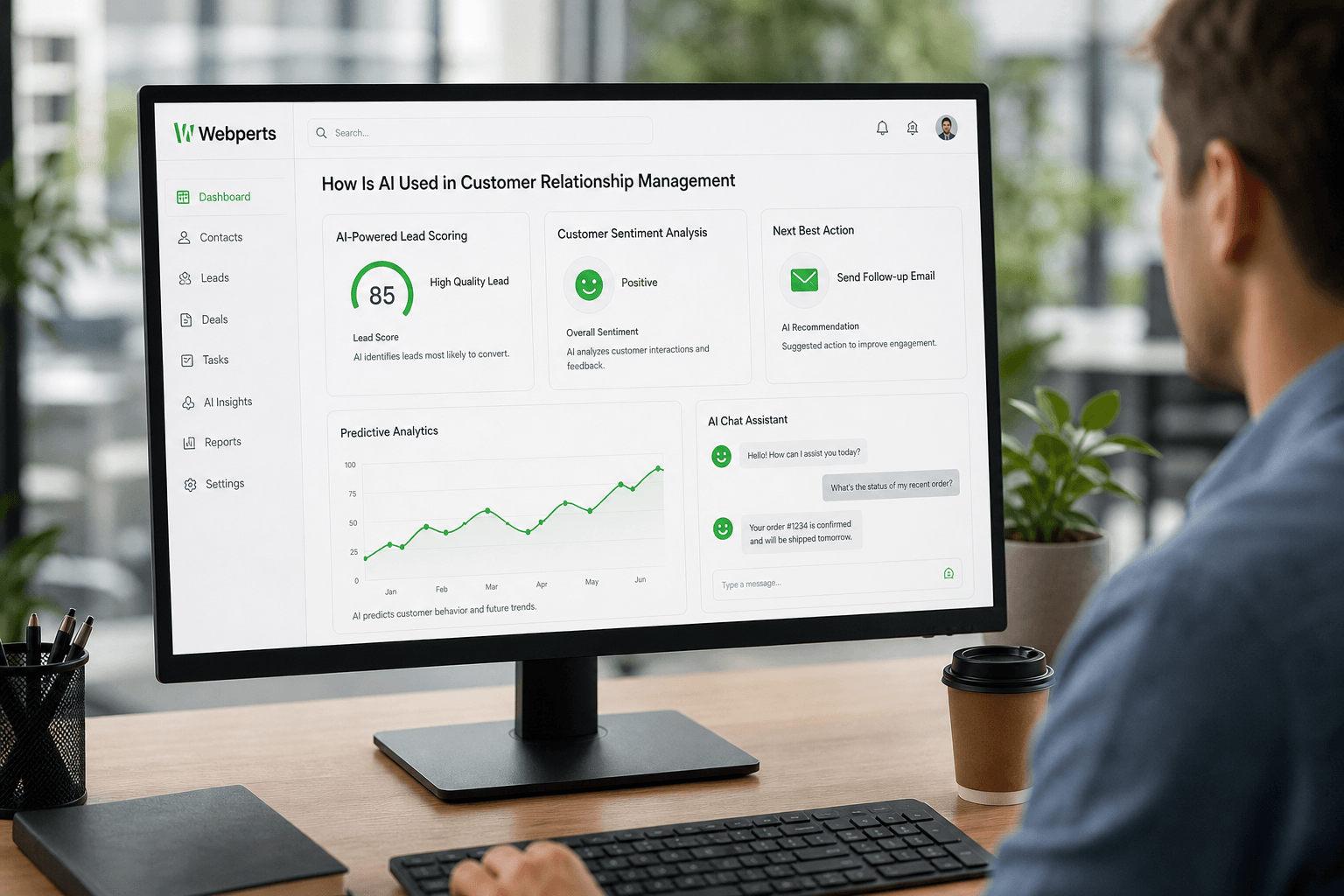
AI is fundamentally changing how businesses manage customer relationships. Companies using AI in their CRM report 30% higher lead conversions, 40% faster customer service, and the ability to predict customer churn 60 days before it happens.
This guide explains exactly how AI is used in customer relationship management — from lead scoring and data enrichment to personalisation, predictive analytics, and the platforms making it all possible.
1
What Is AI in CRM?
Customer Relationship Management (CRM) software stores and organises information about your customers: contact details, purchase history, communication logs, and support tickets. Traditional CRM is a database. It holds data but does not think.
AI in CRM adds intelligence to that data. Machine learning algorithms analyse patterns. Natural language processing understands conversations. Predictive models forecast behaviour. The result: your CRM does not just record what happened. It tells you what will happen next and what you should do about it.
2
AI-Powered Data Management and Customer Profiles
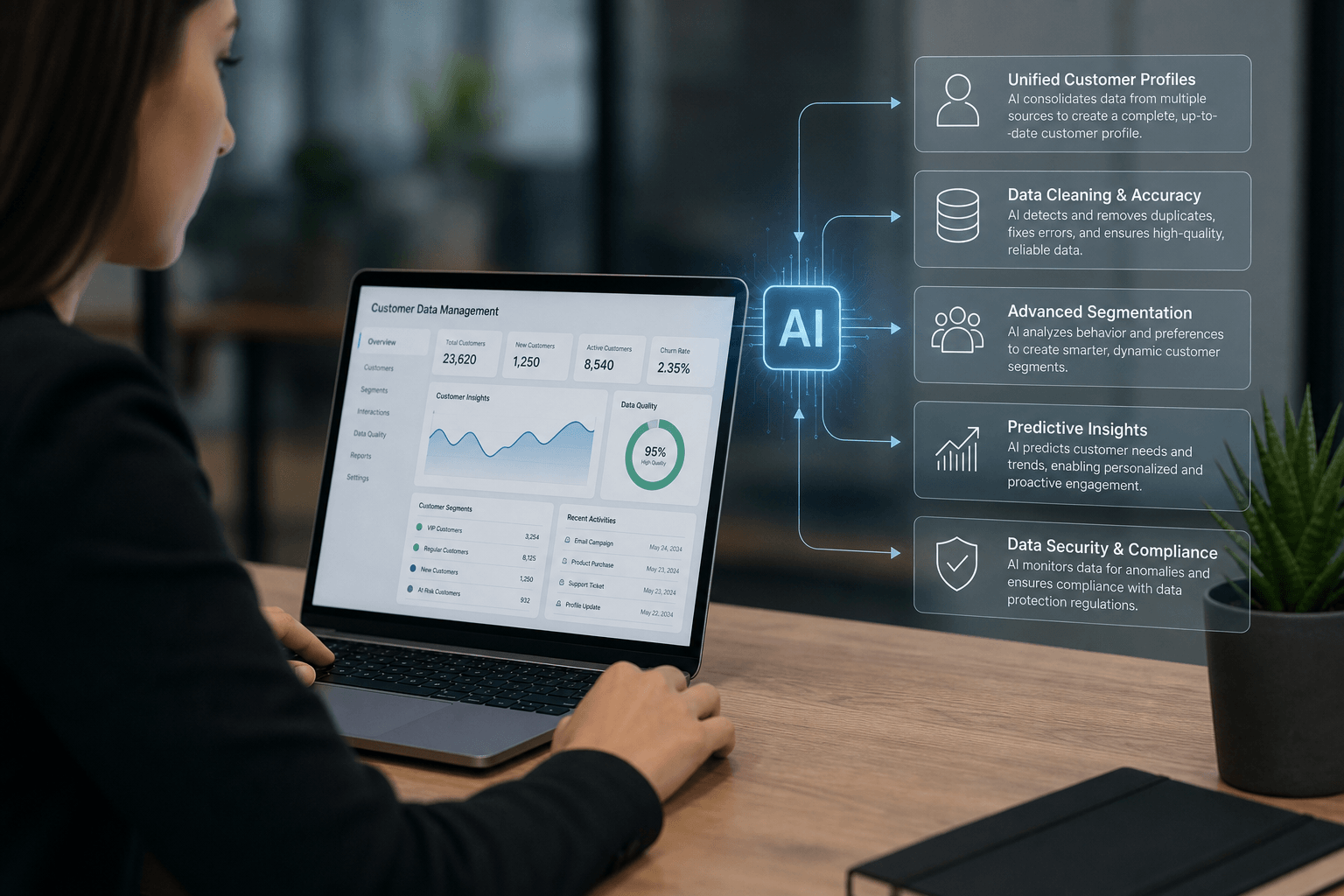
Most CRM systems struggle with data quality. Contacts have incomplete information. Duplicate records accumulate. Data becomes stale. Sales teams waste time correcting records instead of selling.
Automated Data Enrichment
AI solves this by continuously enriching customer profiles from multiple sources: company websites, LinkedIn profiles, news articles, and public business registries. When a lead fills out a contact form with just their name and email, AI automatically populates job title, company size, industry, revenue, and location.
Duplicate Detection and Data Cleaning
AI identifies duplicate records even when names are spelled differently or companies are entered in varied formats. "ADNOC" and "Abu Dhabi National Oil Company" are recognised as the same entity. Merge suggestions appear automatically, keeping your database clean without manual effort.
Predictive Data Completion
Missing fields slow down sales processes. AI predicts likely values based on similar accounts. If 80% of companies in a particular segment have a specific buying cycle, the system flags new contacts from that segment accordingly, allowing reps to prepare the right message before the first call.
3
AI-Powered Insights and Analytics
Raw data without analysis is noise. AI transforms raw CRM data into clear business intelligence that drives decisions.
Revenue Intelligence
AI analyses your entire pipeline and produces accurate revenue forecasts based on deal age, activity history, and engagement signals — far more accurate than human estimates.
Opportunity Scoring
Every deal gets scored on hundreds of signals. Deals showing warning signs get flagged before they fall silent, giving managers time to intervene before a deal goes cold.
Performance Analytics
AI identifies which sales behaviours correlate with winning deals — which emails get replies, which call lengths lead to meetings, which messaging resonates with each buyer persona.
4
Communication Automation
Intelligent Email Assistance
AI drafts personalised emails based on the context of each relationship. It analyses prior conversations, the prospect's industry, and their current stage in the buying process. The result is a relevant, personalised draft that the sales rep can review and send in seconds rather than writing from scratch.
Optimal Send-Time Prediction
AI analyses when each individual contact is most likely to open and engage with emails. Sending the right message at the wrong time wastes opportunity. AI-optimised send times consistently deliver higher open and response rates across campaigns without any manual adjustment.
Automated Follow-Up Sequences
After an initial outreach, AI manages follow-up sequences automatically. If a prospect opens an email twice but does not reply, the system identifies this as a buying signal and schedules a follow-up with a different angle. No lead falls through the cracks because of a missed follow-up.
5
Personalisation at Scale
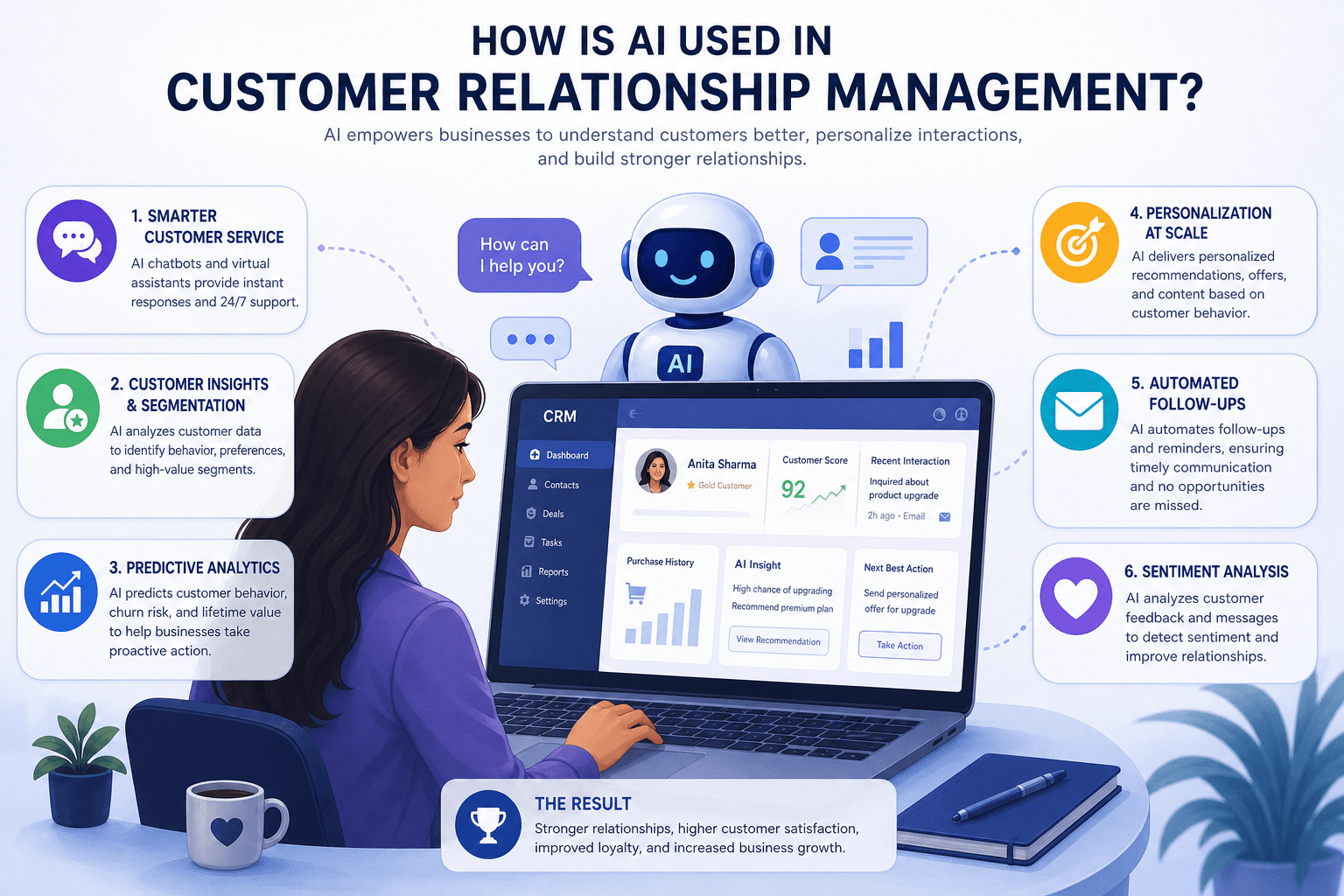
Personalisation is the biggest opportunity in modern customer relationships. Customers expect you to know them. Generic communication gets ignored.
Dynamic Content Personalisation
AI customises website content, email content, and product recommendations for each visitor based on their behaviour, purchase history, and segment. A returning customer who previously bought enterprise software sees relevant upsell content. A first-time visitor from a specific industry sees industry-specific case studies immediately.
$1 Billion in Annual Value from Personalisation
Netflix's AI-powered personalisation engine generates $1 billion in annual value by keeping subscribers engaged with individually relevant content recommendations. By knowing exactly what each subscriber wants to watch next, Netflix prevents churn at a scale no marketing campaign could match.
Personalised Product Recommendations
Amazon's AI recommendation engine generates 35% of their total revenue. The same technology is available to businesses through modern CRM integrations. When a customer contacts support about product A, AI suggests complementary product B based on patterns from thousands of similar customers.
Behavioural Segmentation
Traditional segmentation uses demographic filters. AI-powered segmentation uses behavioural data: what pages customers visit, how long they spend on product pages, what they abandon in their cart, and when they typically make buying decisions. These micro-segments enable hyper-relevant communication that drives real results.
6
Sales Automation and Lead Scoring
Not all leads are equal. The challenge has always been identifying which leads are worth pursuing and when to pursue them. AI solves this with unprecedented precision.
AI Lead Scoring
Traditional lead scoring uses simple rules: if company size is over 100 employees AND they visited the pricing page, assign 50 points. AI scoring analyses hundreds of variables simultaneously and learns from outcomes. Every won and lost deal teaches the model what signals matter most for your specific business.
Intent Data Integration
AI integrates third-party intent data that shows when companies are actively researching solutions like yours. A prospect researching "CRM software for hospitality" across multiple websites triggers a signal in your CRM. Your sales rep gets a notification to reach out before your competitor does.
Deal Velocity Analysis
AI tracks how fast deals move through each pipeline stage and flags deals that are moving too slowly. A deal stuck in the proposal stage for 30 days when the average is 12 days gets a risk flag. Managers can coach before the deal dies, not after it has already been lost.
Sales Forecasting
AI-powered forecasting analyses every variable affecting deal outcomes and produces accurate revenue projections at the deal, team, and company level. Accuracy improves over time as the model learns from your specific business patterns and seasonal trends.
7
AI-Powered Customer Service and Chatbots
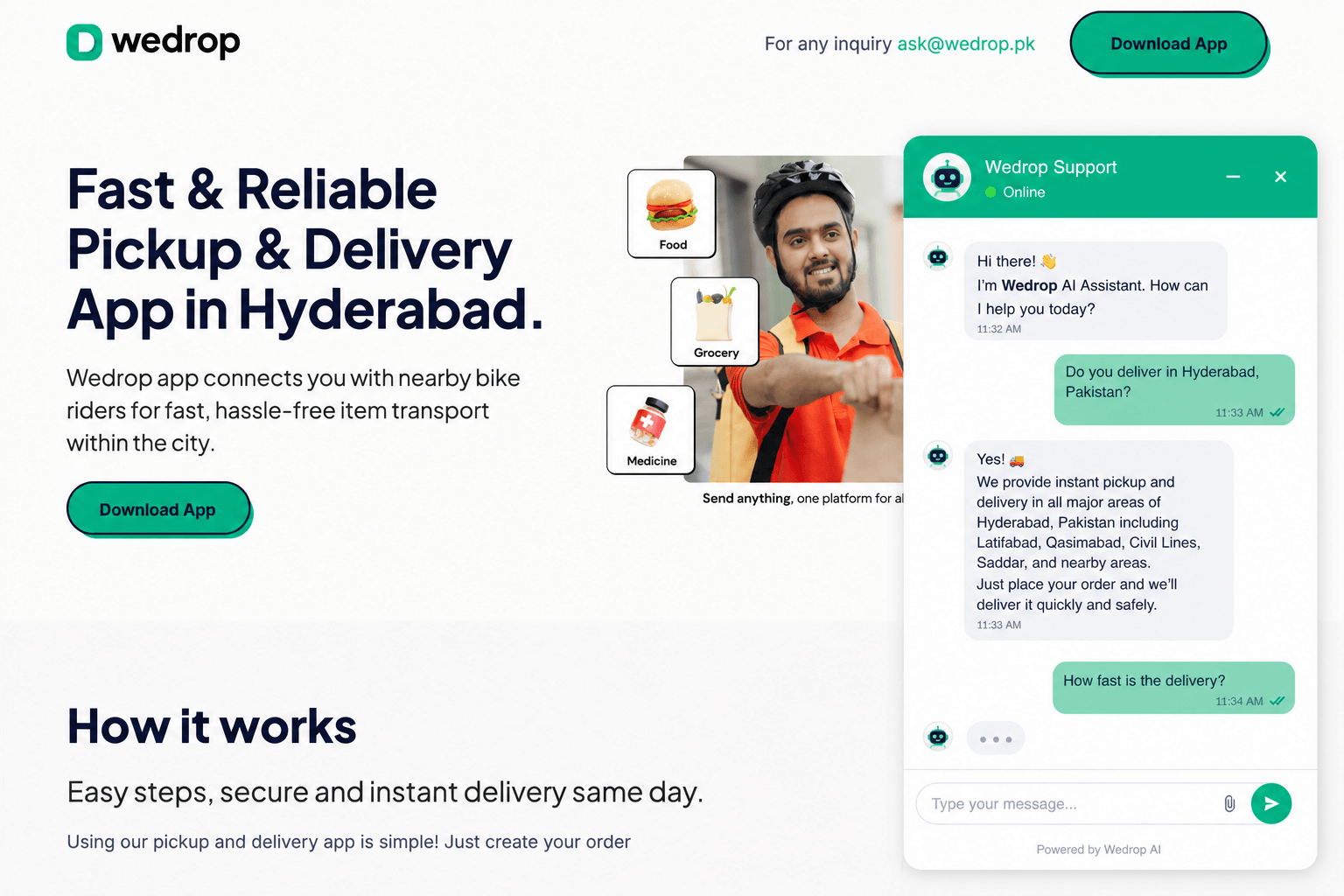
Customer service is where AI in CRM has the most visible impact on customer experience. Customers want instant answers. AI delivers them around the clock.
Intelligent Chatbots
AI chatbots handle tier-1 support queries instantly, 24 hours a day, 7 days a week. They answer frequently asked questions, process routine requests, check order status, and escalate complex issues to human agents with full conversation context already populated.
Erica: 1 Million Requests Per Day
Bank of America's AI assistant Erica handles over 1 million customer requests per day and resolves 70% of queries without human intervention, providing personalised financial guidance based on each customer's complete account history and behavioural patterns.
Intelligent Ticket Routing
When a customer submits a support ticket, AI reads the content, identifies the issue category, assesses urgency and sentiment, and routes it to the most qualified available agent. This eliminates manual triage and ensures critical issues reach the right person immediately without sitting in a general queue.
Agent Assistance in Real Time
AI assists human agents during customer conversations. As a customer explains their problem, AI surfaces relevant knowledge base articles, prior interaction history, and suggested responses. Agents resolve issues faster without needing to search for information across multiple systems.
Sentiment Analysis
AI monitors customer interactions for emotional signals. When a customer's tone shifts from neutral to frustrated, the system alerts supervisors and suggests de-escalation approaches. Catching dissatisfaction early prevents complaints from becoming public negative reviews.
8
Predictive Analytics in CRM
Predictive analytics is one of the most powerful applications of AI in CRM. Instead of reacting to what happened, businesses can prepare for what will happen.
Churn Prediction
Losing a customer costs 5-25 times more than retaining one. AI churn prediction models analyse engagement patterns, product usage, support ticket frequency, and contract renewal history to identify customers at risk of leaving before they decide to go.
Customer Lifetime Value Prediction
AI calculates the predicted future value of each customer based on purchase patterns, product usage, and growth trajectory. Sales teams use CLV predictions to prioritise accounts for upsell and cross-sell efforts. Customers with high predicted CLV receive premium service levels that justify the investment.
Next Best Action
AI recommends the optimal next action for each customer at each point in the relationship. For a customer who has not purchased in 90 days, the next best action might be a personalised win-back email. For a growing customer who has expanded usage, the recommendation might be a quarterly review call to introduce the enterprise tier.
9
Marketing Automation with AI
Marketing automation existed before AI, but AI makes it genuinely intelligent rather than just scheduled and templated.
Campaign Optimisation
AI continuously optimises campaigns by analysing which messages, images, subject lines, and calls-to-action perform best for specific audience segments. A/B testing that used to take weeks now produces results in hours as AI accelerates iteration and learns from every interaction.
+35% Coupon Redemption with AI Personalisation
Kohl's AI-powered marketing system increased coupon redemption rates by 35% by personalising offers based on individual shopping patterns. The same offer, delivered at the right time to the right person, performs dramatically better than generic campaigns sent to the full list.
Dynamic Audience Segmentation
AI creates dynamic audience segments that update automatically as customer behaviour changes. A customer who was a casual browser last month might now qualify for a high-intent buyer segment based on recent activity. Static segments miss these transitions; AI-powered segments catch them the moment they happen.
Attribution Modelling
Traditional last-click attribution gives all credit to the final touchpoint before a purchase. AI-powered attribution analyses the entire customer journey and assigns appropriate credit to every touchpoint. Marketing teams allocate budget to channels that genuinely contribute to revenue rather than just appear at the end of the journey.
10
Machine Learning in CRM
Machine learning is the engine behind most AI capabilities in CRM. Understanding how it works helps businesses set realistic expectations and measure results effectively.
Supervised Learning
Trains on historical data with known outcomes. Your CRM learns from thousands of won and lost deals to predict future outcomes. Performance improves continuously as more data becomes available.
Unsupervised Learning
Finds patterns without predetermined categories. AI might discover customers who buy products A and B together have 60% higher lifetime value — revealing opportunities no analyst thought to look for.
Reinforcement Learning
Optimises decisions through trial and feedback. AI email systems test different approaches, observe results, and continuously adjust toward actions that produce the best outcomes for your audience.
11
Natural Language Processing in CRM
Natural language processing (NLP) enables AI to understand and generate human language. This capability transforms how CRM systems interact with data and with users.
Voice-to-CRM Entry
Sales reps speak their meeting notes. NLP transcribes and structures the information, extracting key facts — timeline, budget, decision makers, next steps — into the correct CRM fields automatically.
Conversation Intelligence
AI analyses sales call recordings to identify patterns that predict deal outcomes. Which questions do top performers ask? How often does the rep talk versus listen? Every call becomes coaching data.
Feedback Analysis
AI reads customer reviews, survey responses, and social media mentions to extract structured insights at scale. Common complaints become actionable product priorities rather than unread survey results.
12
AI for Customer Retention
Proactive Engagement
AI identifies the optimal moment to engage each customer based on their usage patterns and relationship stage. A SaaS product that detects a customer has not used a key feature sends a targeted tutorial at the right moment. An e-commerce platform that identifies a customer nearing their annual purchase anniversary sends a loyalty reward before the date.
Loyalty Programme Optimisation
AI personalises loyalty programmes for each member based on their behaviour. Instead of generic point accumulation, high-value customers receive personalised rewards aligned with their preferences. This increases redemption rates and strengthens emotional connection with the brand over time.
Win-Back Campaigns
AI identifies recently lapsed customers who have high reactivation potential based on their historical engagement and purchase patterns. Personalised win-back campaigns targeted to this specific segment consistently outperform generic "we miss you" campaigns sent to all lapsed customers.
13
Workflow Automation
Manual workflows slow teams down and create errors. AI-powered workflow automation handles routine processes with precision and speed, freeing people for work that requires human judgement.
Intelligent Process Routing
AI determines the optimal workflow path for each case. A high-value enterprise customer gets routed to a senior account manager. A standard issue follows an automated path. The right process applies every time.
Approval Automation
Discount requests, contract amendments, and proposal approvals follow AI-determined routing based on deal size, customer tier, and requested terms. Standard approvals resolve instantly. Exceptions go to the right authority.
Task Management
AI creates and assigns follow-up tasks automatically. When a contract is sent, AI schedules a day-3 follow-up. When a demo is completed, AI creates a proposal deadline. Sales reps never miss a next step.
14
Benefits of AI in CRM
These are not aspirational projections. They are measured outcomes from businesses that have implemented AI in their CRM systems and tracked the results over time.
| Benefit | Measurable Impact |
|---|---|
| Lead conversion improvement | 30% higher (Salesforce) |
| Win rate with AI lead scoring | 20-40% improvement |
| Average handling time reduction | 30-40% (Zendesk) |
| Churn prediction accuracy | 80-90%, 60 days advance warning |
| Retention improvement on profits | 5-15% doubles profits (HBR) |
| Revenue from AI recommendations | 35% of Amazon's total revenue |
| Support resolved without humans | 70% (Bank of America Erica) |
| Coupon redemption improvement | +35% (Kohl's AI) |
| AI-assisted customer conversion lift | +60% (North Face) |
15
Challenges of Implementing AI in CRM
AI in CRM delivers real results, but implementation is not without obstacles. Understanding the challenges helps businesses plan effectively and avoid costly mistakes.
16
AI in CRM by Industry
Financial Services
Banks use AI to personalise investment recommendations, detect fraud in real time, automate KYC compliance, and identify high-net-worth prospects. Bank of America's Erica is the benchmark for AI customer service at scale.
Retail & E-commerce
Retailers use AI for personalised recommendations, dynamic pricing, cart abandonment recovery, and loyalty optimisation. North Face found AI-assisted customers convert 60% higher than unassisted visitors.
Real Estate
Property agencies use AI to match buyers with properties based on behavioural signals, predict which listings sell fastest, and identify investors likely to expand their portfolio.
Healthcare
Healthcare providers personalise appointment reminders, predict no-show probability, and identify patients who may benefit from preventive interventions before problems escalate.
Hospitality & Tourism
Hotels use AI to predict which amenities each guest will value, when they are likely to book again, and what communication cadence maintains engagement without feeling intrusive.
17
Leading AI-Powered CRM Platforms
Salesforce Einstein
The most comprehensive AI layer in enterprise CRM. Features include Lead Scoring, Opportunity Insights, Conversation Intelligence, Predictive Forecasting, and Einstein Copilot generative AI assistant.
HubSpot AI
AI tools focused on mid-market accessibility. Features include email subject line optimisation, content assistance, conversation intelligence, and predictive lead scoring. Free tier available.
Microsoft Dynamics 365
Deep integration with Microsoft 365, Teams, and Azure. Features include relationship intelligence, sales insights, customer service analytics, and generative AI through Copilot.
Zoho CRM (Zia)
Zia offers lead and deal predictions, anomaly detection, automated workflows, and sentiment analysis. Integrates across the broader Zoho suite including marketing, support, and HR tools.
Pipedrive AI
Sales-centric AI: deal probability scoring, activity suggestions, and pipeline health monitoring. Clean interface accessible for sales teams without dedicated technical support.
18
Future of AI in CRM
AI capabilities in CRM are advancing rapidly. Several trends will define the next three to five years for businesses in every industry.
Generative AI
Sales proposals tailored to each prospect. Service responses matching brand voice precisely. Gartner predicts 50% of CRM will include generative AI by 2026.
Autonomous AI Agents
Beyond recommendations, AI agents will take actions autonomously — scheduling meetings, drafting follow-ups, updating deal stages, and escalating at-risk accounts without human instruction.
Conversational AI
Juniper Research predicts 70% of routine customer service interactions will be handled by conversational AI by 2027. The distinction between chatbot and human will become indistinguishable.
Hyper-Personalisation
AI will move beyond segment-level to true individual personalisation. Every interaction uniquely tailored to that specific person at that moment based on real-time context and complete relationship history.
Voice & Multimodal AI
CRM systems will process voice commands, image inputs, and video content. Sales reps navigate their CRM through natural conversation. The interface between humans and CRM becomes invisible and intuitive.
19
How to Implement AI in Your CRM
Implementation success depends on doing the right things in the right order. Rushing to add AI without foundation work produces poor results and frustrated teams.
- Step 1 — Audit Your Data Quality: Assess data completeness, accuracy, and consistency. Establish a baseline and set measurable targets. AI built on poor data produces poor results regardless of platform.
- Step 2 — Define Clear Use Cases: Lead scoring for a pipeline problem. Churn prediction for a retention problem. Service automation for a support capacity problem. Start specific.
- Step 3 — Choose the Right Platform: Evaluate based on industry, business size, existing tech stack, and chosen use cases. Proof of concept on real data tells you more than vendor demonstrations on curated examples.
- Step 4 — Integrate Your Data Sources: Connect your CRM to email, calendar, website analytics, support desk, and any systems that hold relevant customer data. AI performs best with complete interaction history.
- Step 5 — Train Your Team: Focus training on business outcomes, not technical features. Show sales reps how AI lead scoring saves time and closes more deals. Sell the benefit before training the mechanics.
- Step 6 — Measure, Iterate, Scale: Establish baseline KPIs before launch: lead conversion rate, average deal size, time-to-close, support resolution time, CSAT. Measure monthly. Expand what works.
20
Real-World Examples of AI in CRM
Complaint Resolution: 8 Days to 2 Days
L'Oréal implemented AI in their customer service CRM to classify incoming complaints and route them intelligently to the right teams. Resolution time dropped from 8 days to 2 days. Customer satisfaction scores increased significantly while the same team handled a higher volume of cases.
AI-Assisted Selling: +60% Conversion Rate
North Face integrated an AI recommendation engine into their customer service and e-commerce experience. Customers using AI recommendations convert at a 60% higher rate than those shopping without AI assistance. Revenue per interaction increased substantially across all channels.
Erica: 70% Resolution Without Human Agents
Erica is Bank of America's AI-powered financial assistant integrated into their CRM and mobile app. It handles over 1 million customer requests daily, resolves 70% without human involvement, and provides personalised financial guidance based on each customer's complete account history.
$1 Billion Annual Value from Personalisation
Netflix's recommendation engine saves an estimated $1 billion per year in reduced churn. By keeping subscribers engaged with individually relevant content, AI-driven personalisation is the single largest retention tool in their entire business model — worth more than any marketing campaign.
35% of Total Revenue from AI Recommendations
Amazon's collaborative filtering AI, powering "Customers who bought this also bought" and personalised homepage recommendations, generates 35% of total company revenue. The clearest evidence of what AI-powered personalisation achieves when applied at scale across every customer interaction.
21
AI in CRM Readiness Checklist
Use this checklist to assess your readiness before investing in AI for CRM. Click each item to mark it complete.
22
AI in CRM: Key Statistics
| Statistic | Source |
|---|---|
| AI-enriched profiles improve lead conversion by 30% | Salesforce |
| AI lead scoring increases win rates by 20-40% | Industry Research |
| AI reduces average handling time by 30-40% | Zendesk |
| Churn prediction accuracy: 80-90% at 60 days | ML Research |
| 5-15% retention improvement can double profits | Harvard Business Review |
| Bank of America Erica resolves 70% without humans | Bank of America |
| Amazon AI drives 35% of total revenue | Amazon |
| Netflix AI saves $1 billion/year in churn prevention | Netflix |
| North Face AI-assisted customers convert 60% higher | North Face |
| L'Oréal reduced resolution from 8 days to 2 days | L'Oréal |
| 50% of CRM will have generative AI by 2026 | Gartner |
| 70% of routine service by conversational AI by 2027 | Juniper Research |
23
Final Thoughts
AI is not coming to CRM. It is already here, and the gap between businesses using it effectively and those ignoring it is widening every quarter.
The businesses winning in Dubai and across the region are using AI to convert leads more intelligently, serve customers faster, and retain relationships more effectively. They do not have bigger teams. They have smarter tools working for them continuously.
If your CRM is still just a database — recording what happened but not predicting what will happen — you are leaving measurable revenue on the table.
Ready to Make Your CRM Work Smarter?
The Webperts team works with businesses in Dubai and the UAE to implement intelligent digital systems that drive measurable growth. Whether you are evaluating AI-powered CRM platforms, integrating existing tools, or building customer-facing AI experiences — we bring the technical expertise and business understanding to make it work for your specific context.
Get Your Free AI & CRM Audit →Explore Digital Marketing Services